


Welcome to the 30/30 Project, an extraordinary challenge and fundraiser for Tupelo Press, a nonprofit 501(c)(3) literary press. Each month, volunteer poets run the equivalent of a “poetry marathon,” writing 30 poems in 30 days, while the rest of us “sponsor” and encourage them every step of the way.
The volunteer poets for April are Maureen Alsop, Bob Bradshaw, Sarah Carson, Stan Galloway, Ava Hu, Sergiy Pustogarov, Nat Raum, Daniel Avery Weiss, and MK Zariel.
If you’d like to volunteer for a 30/30 Project month, please fill out our application and warm up your pen!
February - Poem 2
Winter Oaks / Kristine Anderson
hold onto brittle brown leaves,
frozen in snow, battered by nor’easters:
marcescence,
unwilling to let go.
Aspen, dogwood, alder
splash landscape in autumn, then
abscission—
shedding, separation, release.
April buds explode to flower and fruit,
ripen and return to the earth:
senescence,
elegance of aging.
The Shadow Knows / Barbara Audet
If Ogden the poet today were living,
About this Groundhog tradition,
he'd express much misgiving.
I suspect he'd be pondering how such a mere rodent,
Could annually offer weather advice many consider so potent?
Rather, I think Nash with humor would question,
how Phil, the dear woodchuck,
mastered climate projection.
Gauging winter's demise by plain shadow reckoning?
While outside his burrow, snow-weary humans are beckoning?
No llama lament now, poets put Punx to the test,
keeping score by thermometer or give it a rest.
For if winter braves on
despite shadow prognosis,
then it's high time to admit,
trusting groundhogs
makes no sense.
untitled / Bee Cordera
Like Roses / Ashby Logan Hill
Fingers holding all that’s left of glacial prairie, your way home
like roses, begonias, bamboo shoots, your walk to the flower market.
Last night, around six thirty, you skated on the ice like rain-song.
You stood leaning on the I beam in the center of the room
watching every member of the band laugh and dance.
You were like an ant in the middle of a bed of roses,
red as strawberries in summertime or the bits of blood
that dripped from your fingertips when pricked because in haste
the thorns remained at first for you primordial glimpse of beauty.
It was an unlearning like this that taught you something new.
And yet, like you, you hadn’t had the heart to name it you said.
And you still wanted the little drips like tie dyed silk ribbons.
Like roses, a cold winter’s breath, a silent song I said.
And afterwards still you and I left, the only ones singing.
Abundant Joy / Amy Marques
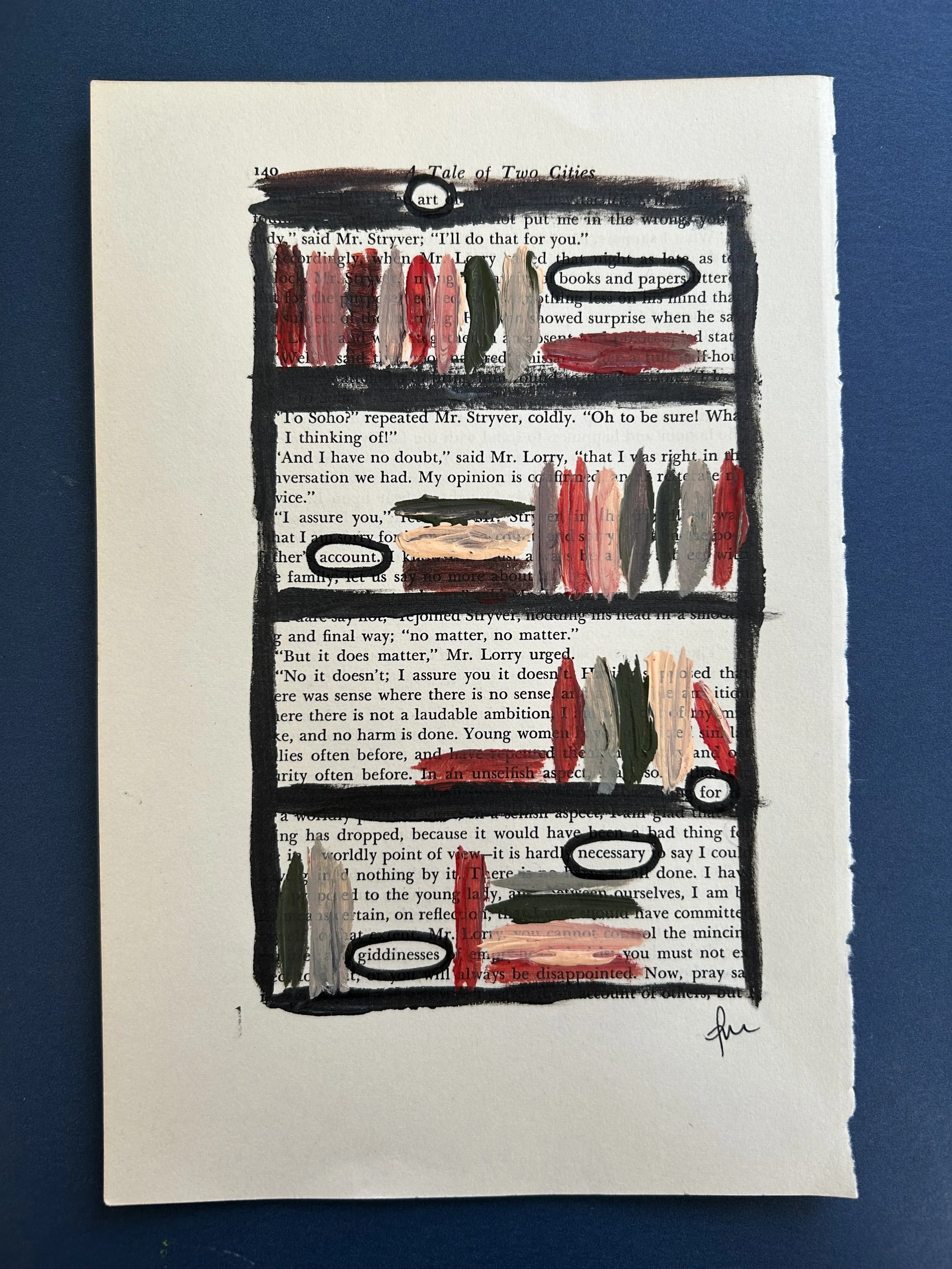
art
books & paper
account
for necessary giddiness.
Source material for erasure: A Tale of Two Cities, pg 140
Loss / Sonia Sophia Sura
When you
love something
you
couldn’t
bear
to
live
with out,
When you
lose something
you
couldn’t
bear
to
live
with out,
Enjoying the Silence of / Samuel Spencer
I remind myself
not every moment of this life
needs the accompaniment of a well-tailored
Spotify playlist – not every chore
needs chords; not every task
needs tunes.
Sometimes the best song is silence –
songs you cannot store, compile for later;
the songs of a moment you must endure.
Some of the biggest hits include:
Wind passing through leaves.
A distant train horn.
The boiling of a pot of coffee.
A splintering campfire.
Rain.
The mourning dove (work harder).
The mourning dove extended version (drink lager).
And let’s not forget about the lapping waves.
I, for one, pride myself on having
a more eclectic taste in silence.
I mean, not to brag, but I’ve been known to enjoy:
Tires on the interstate.
A dinner alone.
Cicadas.
The anticipation of diagnosis.
A summertime lawnmower.
The hum of a microwave.
The milliseconds thereafter “Do you love me?”
But what I love most of all
is the silence of a poem concluded.
That magnificent white space
devoid of words, yet which holds so much more
than you and I could ever contain,
contain,
contain,
contain,
contain,
con… (sorry, this one’s got a scratch).
February - Poem 1
The Noise / Kristine Anderson
“. . . write with the noise.”
—Susan Muaddi Darraj
Inside my home
the warm kitchen silent
except for the metronomic tick
of an old-fashioned wall clock
Outside the window
late afternoon casting shadows
sharpened by triangles of sunlight
on undulating stretches of icy snow
Beyond this: clatter
of the world. Scraping
of snow plows clearing roads,
sirens of ambulances rushing
to the ER, crack of a pine branch
splitting off. Report of a gun.
And everywhere, it seems,
the breaking of glass
Belongs / Barbara Audet
Every sign I carry.
You carry.
Every raising of my hand with yours says
we are mind full.
Of worry.
Of pain.
Of awareness that only hands held, fingers squared, will have strength.
A hand held sends
its grip straight
to holding a heart
in place.
Against all
that would end
its beating.
The hand
generates the sign.
The heart maintains
its worth.
Pose 4 the Bandit / Bee Cordera
A Good Thing / Ashby Logan Hill
A loose thing, forgiveness, untethered, a skein of yarn
undoing in time, a good thing that comes like the stiff wind,
the dark night, monks on their way north, a narrow road to the
clifftop chateau, a desert sun not far from Tortilla Flats, Arizona,
a hell of a thing at Hellsgate Wilderness, a forest of pine trees
and hot springs, in the day, too hot for a bike ride, the windows
down and your friends in the back of your truck at dusk, then
moonglow thereafter, loose, untethered, a kite string’s whisper
and rattled about the sand dunes, and yet a turn you take today,
again a thing unfathomable, untouched snow drift, the ocean
and sandpiper dunes, the sun, golden topaz sandstone where
wooly mammoths used to roam, only leaving their footprints below,
mountain top cranberry bogs, Tobacco Row and lakes that look like
fingers holding all that’s left of glacial prairie, your way home
Delightful Though Disapproved / Amy Marques
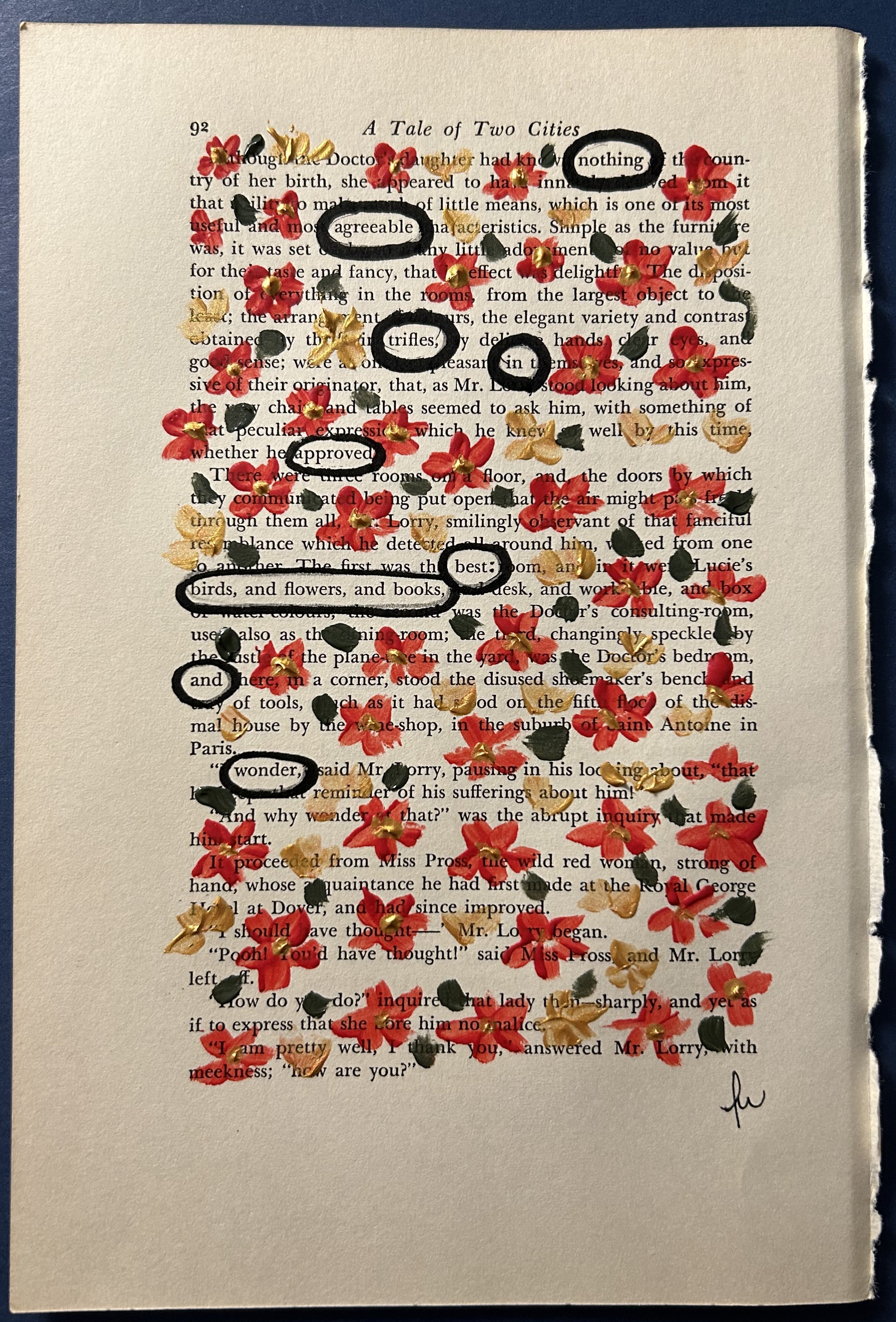
Nothing agreeable trifles
in approved best:
Birds, and flowers, and books
and wonder.
Source material for erasure: A Tale of Two Cities, pg 92
Standing in the Garage / Sonia Sophia Sura
I didn’t know it yet,
but he’d become a
second
dad to me,
the man,
shirtless and waving
a sword
through the air
during a thunderstorm…
We stood in the garage,
door open,
eight or six or
ten of us,
looking for him
when the lightning was not
being our sky-lamp.
The storm had gone on for hours,
I know this because it had been hours
since I
saw clearly;
someone found my
glasses
on the bench the next day;
When the rain came,
we took off our shirts
and started running.
The creek is down the road,
a few minutes driving
(one person in the seat,
the others on top of the car),
or an 8 minute run.
I don’t remember putting my
glasses on the bench.
When the lightning struck,
some of us
got scared.
By some of us,
I mean only
the Father
of my
two friends,
who became family to me
long after
the Father arrived
at the creek
and
screamed at us.
He asked us
why we’re
idiots.
It’s dangerous,
he said,
to be standing
in the water
during
a lightning storm.
It’s dangerous,
to wave a sword around
during a
lightning storm,
but not for all
of us
delinquents (we
could be considered
as)
standing in the
garage.
Toddler Watching an AI-Generated Show / Samuel Spencer
I feel bad for the artists
who had their work stolen, all so a pair of parents
could eat and talk in peace.
I feel worse for the child, buckled down
in the restaurant highchair, anesthetized
by a screen pretending to be an acid trip.
I look around to see if anyone else sees
what I’m seeing, but no one does –
I can almost literally see the child’s life force
leaving his eyes and entering the screen,
the realm that holds his attention and (soon)
his dreams.
The restaurant revolves around the scene.
No stops and screams because they don’t see what I see:
The death of the innocence of a child;
a child so close – yet so unseen.
January - Poem 31
Cento to Melt Ice / Composed by Haley Bosse
with lines drawn by and from Tess Adams, Haley Bosse, Jess Bowe, Joanna Lee, Thomas Page, Sarah Paley, and Amy Snodgrass.
While everyone waits for the storm to come,
to hush and quiet. we live
the looming fabric waving
the past uncovers.
a line of police cruisers, sirens mute in the before-dawn
Look, the moon said,
A whistle breaking open
This is where we begin, in the mud with the red–
first note carried through the tunnel
like blood like blood like blood
marking lines of ruin across the map.
They are coming. The signal fires are lit.
and, yes, words
against such relentless
boots?
language to speak the loss that has hollowed me out.
The roar of the engine is a dare.
And for love that is stronger than death.
–it is almost within arm’s reach
My heart too – on a leash that I seldom remember to slacken.
An ungovernable force all my own.
It ebbs and flows like the tide full of red blooms and seaweed clouds.
before the world realizes you’re not dead and buried
today, you are still
much too small and alive.
I am not sure I can survive your brightest now.
The crackCRACK
of oversaturated tree trunks
every bucket of midnight
the laying on of their hands.
A cloud circles in and circles out. It drops then spreads.
what do you call that then?
to carry love down the sidewalk,
a song unafraid of its fear.
over a river running black and unpersuadable
over dark cars and dark asphalt
out of my skin, unbloomed.
and you reach your hand
to the human next to you,
stretched like a kitestring as the wind
who dared to venture out into the clear day—
over the windows like eyes and eyes and eyes
to the middle. come walk with me
I am stuck in every tonight
and people are singing somewhere
a hope escaping
the water never
falling still
for those who stay to dare, waiting in the rain.
finally, I become
a tiny cloud
Your life is as valuable as mine. Your life is as valuable as mine. Your life.
Its roots stretching
to guts, to muscle, to skin, quicker than you can blink
// the undulating sidewalk // full of cracks // and fissures //
Our lungs so like ocean
waterways of a dream;
sound waves swallowing
The scrape of your calluses on broken concrete,
trying to navigate // to any public place // under heaven
they cannot hear the song I sang. I sung.
That will not be washed away
today I fall with its grit.
reborn into the air
and I gasp
The worms surfacing from puddles,
i imagine i’m as common as the wind, as ordinary as any leaf left for winter’s bed.
Greenbright between their veins
a surgeon’s neat crosshatch
and feet to kiss the cold of the ground
Involuntary traveler, there is no cure for memory.
what we mean: we were, we are, so lost, so lucky, so lucky, so lost.
cold hands reaching for cold stars
a brighter ending, or less clouded eyes
January - Poem 30
My Gender / Haley Bosse
as the last resort
in a storm-wrecked beach town,
as a slight of hand
by a man in patched-over socks,
an allergic reaction
to a friend’s unpredictable cat
or a dazzle of seagulls’
clean bellies from below,
Schrödinger’s kit
tucked away in the attic,
the birds tipping forward
to disappear in the fog
on the eve of three / Jess Bowe
you demand and you dance and you eat
three breakfasts before nine.
i watch and i watch and i watch
you run and blink and breathe.
you carry a flag and a truck
and build walls and trees
and vacuums that don’t plug in.
you chase the cat and lay on the dog
and dip your hands in the water bowl.
you sneak behind the couch and open
the window to all six degrees outside.
you fill a cup twenty-eight times
and spill christmas in paris tea
and cry when i'm first to the mess.
you refuse to nap.
you crush cereal with your bike tires.
you spin in circles when the devil
goes down to georgia, air fiddle
propped between chin and belly.
you save the chickens your apples
and say hello to the stinkbug
and you never, not once, ask
to be anyone else.
you cry and hug in the same hour.
throw a spoon across the table
and tell me that i’m okay.
not once, do you ever, look beyond
the treeline and wonder
where any of your life has gone.
Self-portrait as Bruegel’s MFA admission essay / Joanna Lee
Chemical composition of leftover stardust, of iron & saltwater & afraid to take that leap off the old pier. older, now. but not so much i can’t remember the smack of the cold Atlantic or the smell of a Chicago bus station alone, and his name, Ravi, through the long midnight blue hours / shoulders that carried such weight / in canvas i paint myself always with bigger eyes, except the time i highlighted my own skin pink to prove something to someone i refuse to recall / shoulders that still carry such weight / that want to do right but don’t always know what that means. feet turned south / collector of rosary beads and little scars, most / comfortable in corners, in lowercase i’s, but / will always walk like a surgeon : a learned instinct for tying knots : a pretender at many things / a listener / bad at disappointment and no love for rearviews, yet / a secret desire to retract the wounds of my wounded, unpick the scabs / extravasated wolf song / dehisced tideline. sadly wingless, but that applies to most of us. whatever it is you are looking for, i am not it.
Movies / Thomas Page
There isn’t much you and I can do together
except for watching movies all day long.
You tend to pick ones that I find slow
and I pick ones that you find boring.
It seems that we have different tastes—
you hate the movies that I find moving.
Maybe it’s because we’re at different stages
and I’m more willing to put up with garbage.
Glitzy garbage wrapped in a criterion shell
while you like ones like cherry bombs.
Cherry bombs exploding in bad guys’ faces
thwarting plans to blow up oil refineries.
How many two hour spans can we
watch the lives of others unravel?
How many permutations of others’ lives
can we see before we decide we’ve seen it all?
I’ve been keeping track of the movies we pick
and it seems that there’s dozens to replace them.
Is there ever an original idea that hasn’t been
made into onionskin copies?
How many yous and how many mes
have had this same conversation?
This same conversation while watching the same movies
as the snow falls like some worn out metaphor?
We Dead / Sarah Paley
I am dead along with the other dead
We are looking at ourselves dead.
The squirrel is particularly upset because, dead,
he looks like a rat and people step over him in disgust.
He had a fluffy tail he was proud of. But he’s dead
now so what does it matter?
I guess I can’t really fault him because I wish I looked better dead.
Among the dead are people I would rather not see.
It’s a real mess here. Confusing. People died
at the wrong time and now they barely know or recognize
each other. The young widow is a dead hag. Her husband
doesn’t know what to do. She looks like his mother, who is,
of course, also dead and she never liked the wife.
I die many times a day. Sometimes I am hit by a bus.
There I go up Sixth Avenue like Wile E. Coyote splayed
on the front. Children under five are amused. They think
I will be fine – just peel myself off and fill back up. But I’m dead.
Their parents try to cover their eyes to protect them.
Sometimes something falls and crushes my head.
The friend I was walking with is horrified, she has
blood all over her new jacket and does she even know who to call?
Sometimes someone kills me. Sometimes I kill myself.
Sometimes people mourn. Sometimes no one cares.
I always wince when I die to try to make it go away.
We dead are embarrassed by how we feel and how much we want.
It has always been this way.
Gratitude / Amy Snodgrass
A tree with deep and lovely grains, filled
to burst with the sweetest honey, stands
tall and proud on the horizon. Stark and
clear, it holds truth in a cheeky wave. Another
fiery fall awaits, but for me, it is time to let go.
Just now, I read Billy Collins’ “Forgetfulness”
and it about killed me. No metaphor. No hyperbole.
People don’t know how you feel unless you tell them.
Just now, I read Fia Skye’s lines about lies, lines
that set me straight or at least a little straighter,
making me believe I can strengthen the marrow in
my bones again, strong enough to pause and listentrue.
Just now, I searched for a vaguely remembered line (and succeeded
quickly–phew!): a line from David Kirby’s “This Magic Moment,” which
of course all moments are, saying “Poetry does make things happen.”
The search also resulted in Auden’s “In Memory of W.B. Yeats,” which
is beautiful–but did not almost kill me.
I want to be better. In 6th grade, Mrs. Haase told me my poems couldn’t
include full sentences. I was furious, in my way of not knowing what that
meant or that I had the right. I let her silence me.
She was not a good teacher. My whole style now defies her,
but I think maybe she wasn’t wrong…. She just wasn’t nice.
People don’t know how you feel unless you tell them.
Just now, this memory made me search for Herbert Kohl’s I Won't Learn from You and I
discovered it has the most fantastic subtitle that I hadn’t remembered: And Other Thoughts
on Creative Maladjustment. People don’t know how you feel unless you tell them. I want to
be better. More creatively maladjusted. Less full-sentenced. More magic. Ready to bend.
More open to being wasted by words.
So now, I will wait for myself, for the flow I trust will come, and I will write this,
my aching thank you to the dear tupelo tree: stark and cheeky, glorious and real.
January - Poem 29
The Flower Chair / Haley Bosse
Its spray of once-cream silhouettes
For so long, too light for me to touch,
Always in the corner of my eye
As I slid in socks across the wooden floor
To throw my backpack in the closet,
Palms peeling from swinging from the monkey bars
One stubborn minute before falling in the sawdust,
Bleeding around the nails from where I’d ripped the skin,
Mostly dry and cracking even in the rainy months,
The wind blowing broken stalks
Of blackberry bushes past the window,
The summer grasses of the flower chair
A continuity of somehow unstained,
Clean enough when we spotted it
Between orphaned floor lamps
At the Goodwill, given away
While we were missing, one loss
Among everything but a week’s worth of clothes
And the books we were reading when we left,
Waterlogged pages passed from my mother’s hands to mine,
To my sister’s in the big bed in the basement
With windows too high for us to ever shut. We’d gone
To the Goodwill to replace what had been taken
With other people’s things
But found the flower chair and the dining table,
Our bookcase and the rest.
I swayed the vote to buy back the chair,
Though I’d never been allowed to sit in it and, after,
I got to sit in it
In the sunshine through the open windows,
And later, when I left for college,
My mother stored it in a corner
Of her shed, covered up and waiting
For my partner to cradle it between his arms
And totter up the metal stairs to our apartment,
How he sits there as he reads,
The chair’s thin fabric softened beneath my palm
As I pass it on my way to sleep.
a revolution / Jess Bowe
i don’t always ask for help with the chickens because i feel answers arrive, first to my legs, lifting bags of feed on my shoulder. i feel answers arrive to my rose-kissed cheeks. the wind sticks to the underside of my hair. i open the door, just as yesterday, and just as yesterday, i tell them hello, feathered friends! and i mean it: friends. i am in love with the day. i am in love with every storm. i am in love with the mid-february edge, the bottom lip of death. the cedar waxwings saying goodbye at my windowglass, crisp-weather drunkards. the pine missing half her face. the stretch between one neighbor and another. i drive to the center of town just to walk on the sidewalks and trip over bliss. my organs are electric and i pretend the light i’m made of is in every color, invisible stained-glass-sun, and today i’m the artist and i paint across the field of every stranger who walks by. i’m in love and i’m not sure how i got here. praying. i do a lot of praying, and i don’t ask if my god is wearing red or blue. i don’t assume to be speaking to a man. what i’m praying to is a river. what i’m praying to has eyes on the inside of me. what i’m praying to looks a lot like my deep breath sounds. a lot like the crackling of stars in the bowl of ice cold sky. i pray, and i pray without permission, and i pray like there’s no tomorrow because no matter how long i live, i still haven’t met one. i don’t ask permission. i don’t ask where you stand. i don’t ask you to throw a fiery hoop in the air, to jump through, to wear my own face, before i lay flowers at your front door. i’m in love, this great big place, this garden without a fence, this hill of birch, this song i find myself to be, on the tongue on the tongue on the tongue of what prays me.
Reporting on the weather (reprise) / Joanna Lee
A man
has died
of over
-exposure under
a walkway
in the city’s North End, hours
before
news spreads
of Them closing
down
the emergency
storm shelter.
Alexa tells
me there’s a
severe
weather warning
for tonight—extreme
cold—and though
I type this
from bed,
faux-down
up to my ears, the heat
tripping steady
as a pulse,
your toes
curled petals
against mine,
I don’t think
I’ll ever again
get warm.
Waiting Room / Thomas Page
2300: I’m awoken to take you to the hospital
0000: I try not to think about why I’m on the highway
0030: We arrive at the hospital and take you inside
0100: My brain finally clams down as you finish your intake forms
0200: I’ve given up on trying to rest my head against the stucco-like walls
0230: You try to lighten the mood by telling me how you feel better
0300: I realize how quiet hospitals are in the dead of night
0330: A tech tells us that the doctor is monitoring your condition
0400: I’m getting delirious at how long I have been awake; I can’t imagine how you feel
0500: The doctor comes in and explains that you’ll be admitted soon
0600: I’m told by you to go home and get some provisions / sleep
0630: I try not to think about why I’m on the highway
Release / Sarah Paley
Doors & windows flung open with abandon
when you arrived. Curtains blew this way
& that in the crisp breeze & it was fun
as you helped replace rusty hinges that lay
askew off their soggy, splintered frames.
I threw out everything & snapped linens
that we would make soft. We came upon
forgotten treasures – lost buttons in old tins.
Then the first door shut as if by accident.
I opened & you came through eventually.
Then another. This one locked. Not meant
to but did. You happened to have the key
but then others closed. Sometimes I’d unbolt.
Hear them now: slam! slam! as I let go my hold.
Facing a Writing Prompt While Missing My Mother / Amy Snodgrass
Mother and voice: my eyes grasp no other words,
of which I need five–and fast–so let’s go! Life is whirring.
A new colleague (my own age) tells me:
“I was so utterly sick, I had to call my mother.”
My heart doesn’t know what hit it, but I do: a cliff.
A cloud circles in and circles out. It drops then spreads.
My daughter admits to licking the salt lamp of my friend whenever we
go to her house. “Do not cook a baby goat in its mother’s salt,” I think.
I could not care less. I wonder what that makes me, and I wonder if it kept
her up at night, this secretive salt-licking. How long had she sat on the guilt?
I wonder: does my response (my surprise and laughter and joy) make
her someone who just takes what she wants? or does it make her feel safe?
And that’s the question, right? Are we good parents?
And how can we go on, when we are sick? And they are gone.
January - Poem 28
Three Decades Cobbled Out of Half-Lives / Haley Bosse
Half-life (noun): the time required for half of the atoms of a radioactive substance to become disintegrated
The girl who bruised my brain
Brought caesium
And when she left
I dredged up fermium
By dancing in the chill.
I caught curium
With a wide-faced spoon,
Sifting through
A steaming bowl of ramen,
Fluorine filtered
As I mouthed at empty air.
These days, I count out bismuth
For my neighbors,
Polonium for my nieces,
Figure if I’m dreaming big,
Berkelium for three more goes
At basking, animal
Beneath the setting sun.
Really, I would settle
For one more thorium
Or even francium
Or the very tip
Of my finger,
The half-life
Of a single fleck of skin.
See:https://en.wikipedia.org/wiki/List_of_radioactive_nuclides_by_half-life
holy house / Jess Bowe
rain shivers down,
heavy and muffling
the grass, hostage
under the weight
of minute globes;
the after-dinner choir
sings its final encore,
chimes and bells
etch their praise
into the ceiling
thick and gray,
dirtied-down
and huddled close
to the ground;
casting out a ribbon
of sound, impersonating,
for a note, the midnight owl
in muddied daylight.
she fronts the chorus
from the black wire,
electric surging
beneath her fragile
feet, praying for all
she sees, for all
we fail to see.
from the height of her
perch, Sun slopes
into Mountain’s chiseled
arm, pushed by her
swallowing cry
looming through the halls
of branches, of night-readied
nests, of ordinary mothers
wiping the ashen dust
of the day from their palms.
The mirrored shades of God / Joanna Lee
Two neighbors, whose names I don’t know,
slide across the street to help
rock my car out of the ice
cage its parking spot has become.
My foot on the gas, the alarm in me rises
with the violence of each convulsion,
their laying on of hands.
Through the windshield, the sun
leaves a slow sinking trail across a landscape
that could be a desert on the moon,
the street ahead slick
as the mirrored shades of God.
The roar of the engine is a dare.
With one huge heave, the rear tires break
free and I am sailing, sailing
on a diagonal across the intersection,
all four wheels purchaseless, un-
tethered by friction,
an ungovernable force all my own.
Our street corner frozen in time, its eyes
out. The light falling, the moment
stretched like a kitestring as the wind
picks up, nothing
between me and a glittering chaos but
classical mechanics—the slowing momentum
as I ease off the gas and let the spin
find its silence. Grin into the hollow.
Look back, then, at how we got here,
grateful for this day, for so many
small miracles across its transept.
Cabin Fever / Thomas Page
When was the last time that I felt comfortable enough to leave you unsupervised?
When was the last time that I felt comfortable enough to leave you?
When was the last time that I felt comfortable enough to leave?
When was the last time that I felt comfortable enough to…?
When was the last time that I felt comfortable enough?
When was the last time that I felt comfortable?
When was the last time that I felt?
When was the last time that I?
When was the last time that…?
When was the last time?
When was the last?
When was the…?
When was…?
When?
?
When You Go Looking For What is Lost / Sarah Paley
Everything is a sign.
The holy ghosts won’t stay put
but if the light stays green long
enough for us to cross the street,
if there is just enough milk
for the morning coffee,
or to find money in a forlorn pocket...
Well, I’m not saying it’s definite
but it’s pretty obvious
that something will give
and free the mind to find
what it is that needs to be found.
Good News / Amy Snodgrass
(for Amy Jacobs and with thanks to @winningnmindset)
In Norway, there is an island with no clocks.
In France, short flights are banned if trains travel the same route.
It’s a relief to know so many ways exist to resist. Call your senator.
Walk frigid sidewalks as one link in a human chain of truth. Know when
your neighbors are huddled and scared behind blackout curtains, and
sneak them a beef broccoli casserole– your mother’s cherished recipe–
and a gallon of milk. Don’t forget the Hershey’s syrup. Marshmallows.
Dutch engineers built an ocean-plastic vacuum cleaner.
Pandas and green sea turtles no longer land on the endangered list.
Use your talents and energy for love. Dream up, design, and build
an Instagram page that highlights good news: save all our nervous
systems from shutdown. Fill up your car and create a safe-ride network
for wary children too shaken to walk to the school bus. Play Shakira.
So many ways to resist. Learn them. Teach them. Do not open the door.
Elephant conservation efforts in Botswana have been wildly successful.
In Ethiopia, in one day, citizens planted 700 million trees. 700 million.
January - Poem 27
27 / Haley Bosse
I climb the ladder
to my father’s distant face,
the heights a blanket
I could reach & pull away.
Below, games of make believe
& ants sifting through the carpet,
the looming fabric waving
on currents from my breath.
horizon / Jess Bowe
A blackout poem, from Shambhala by Chögyam Trungpa.
“The challenge of warriorship is to step out of the cocoon, to step out into space, by being brave and at the same time gentle.”
the magic of time
is the courage to imagine
seeing the Sun
the past uncovers.
So we talk about the weather / Joanna Lee
Ten inches, he says.
And not getting above the high twenties
all week: you know it’s not going anywhere.
He’s not wrong. The snow will lie
between tree shadows
for days, lingering, and he’ll
make his slow way round with the shovel and broom,
cleaning off paths from the carport, test-run the jeep
in 4-wheel to see if it’ll clear whatever the plows
have done to the end of the driveway.
He’s worried about getting out,
about a doctor’s appointment next week—
I don’t have the guts
to ask what he’s thinking right now
about this country. If he has the same sick
crumbling immobility threatening his morning routine.
If the deaths I’m seeing on repeat even make
his evening news. He could still lose power
in this cold, out in the woods as he is,
and ice on the lines. Who am I to add
to his fear of falling?
Greenway / Thomas Page
“Looking back over her shoulder at some fear.
She took a doubtful step and then undid it
To raise herself and look again.”
-from “Home Burial” by Robert Frost
The way back was looking
less pathetic—rainless—when back
this morning I drove over
to your place to tell her
that I wanted to shoulder
some of the burden at
the realization that some
future day’s fear
was about to die. She
made me go and I took
one last chance to say a
goodbye that I was doubtful
I would ever see you again; a step
in the cycles of grief and
then
I drove into the setting sun; Undid
all of the masking to swallow it
down to
raise yourself
to comfort herself
and
to look at your face
again.
Captured / Sarah Paley
My father was just entering what he thought would be his middle age
He was filling out after being young-Sinatra-thin
He’s wearing those soft brown corduroy trousers
I am standing on my left leg, bent forward holding a football at the tip of my raised
right foot as if to kick it in mid-air
A human child-bird with lank hair, chunky glasses, lop-sided smile,
Olive Oyl frame, terrible shorts, shapeless top and there is my father
his arm outstretched to steady me or maybe offer encouragement
He glows in the afternoon light under the scarlet elm with the Mohawk
River in the background
What is the point of being pulled back to this scene that I am not holding
in my hands but sits in a box in a closet yellowing and curling at the edges
The trousers, the lowest branches of the elm, the murky river, the disastrous barn,
the white pillar of the porch where someone stood
my mother? my oldest sister? my other sister? my brother? my other brother?
and captured this moment
My heart too – on a leash that I seldom remember to slacken.
What can we do? / Amy Snodgrass
thanks to Jessica Barba Brown for the prompt
At an exclusive garden-to-table dinner,
she eats the mango salsa despite despising
mangoes. Her friends eye her warily,
hoping the night will not be spoiled:
“Well, it doesn’t taste like mango, so I’m
good.” The tent– tall and wooden-beamed–
fills with relief, laughter, organic wine.
And a sound from above. A nectar bat flies
chirping through the rafters, preparing his
two-grooved, double-body-long tongue
to feed. Swooping in to embrace the night-
blooming mango flowers, he sucks juice
against gravity, and seemingly as an aside,
he pulls pollen until drenched. Lush and
heavy, he darts in erratic turns, off to another
tree. She notices the fading chirp and relaxes,
no longer needing to fear the fangs society
has told her to imagine he has. The bat knows
nothing of power, presumption, arrogance, greed.
Oh, humanity. It is not too late. Make the call.
January - Poem 26
Blueberries / Haley Bosse
Half-thawed
from the back
of the lightless,
breezeless freezer,
soil frothing up
to float
a spinning tire
crusted over
in the image
of the distant
midday sun.
The light drapes itself
across our trembling bodies
then circles back to dance
through the tanager’s uncut song.
The dark below
my tongue
begins to pop
the skin.
the storm / Jess Bowe
the know-ahead gives us time,
we think, to drip the faucets
and spread the salt along
the sidewalks.
deadly as it comes.
driving
and
walking
are impossible dangers,
a heaviness on every surface.
the weight of it
alone
on highways
of electric power
is enough
to leave a city
in the dark.
in Greenland, a mass
sheet loses 8,000 tons
per second.
i can feel it swallow us
from here, calling
for homeostasis
the natural order of things,
one way or another.
Grounded / Joanna Lee
--after Nikki Giovanni
i cannot bring myself
to do anything
about the spider
twitching to and fro
across our kitchen floor,
daring me to smush him
if i don’t watch every step.
i can’t even
sweep him up
in the dustpan & air-
lift him out the back door—it’s
ten-degrees and snowing on our porch,
& so much death outside
already.
Unglamorous / Thomas Page
It seems like everyday I’m cleaning up urine
or finding that the floor is covered in emesis.
I keep taking you to get venipunctures
while she cleans the bathroom of your excretions.
You litter the floor of your rags of mucus
while I cleanse the home with antiseptic.
While I cleanse the home with antiseptic,
it seems like everyday I’m cleaning up urine.
You litter the floor of your rags of mucus
or finding that the floor is covered in emesis
while she cleans the bathroom of your excretions.
I keep taking you to get venipunctures
I keep taking you to get venipunctures
while I cleanse the home with antiseptic,
while she cleans the bathroom of your excretions.
It seems like everyday I’m cleaning up urine
or finding that the floor is covered in emesis.
You litter the floor of your rags of mucus
You litter the floor of your rags of mucus.
I keep taking you to get venipunctures
or finding that the floor is covered in emesis
while I cleanse the home with antiseptic.
It seems like everyday I’m cleaning up urine
while she cleans the bathroom of your excretions
While she cleans the bathroom of your excretions
you litter the floor of your rags of mucus.
It seems like everyday I’m cleaning up urine.
I keep taking you to get venipunctures
while I cleanse the home with antiseptic
or finding that the floor is covered in emesis.
Or finding that the floor is covered in emesis,
while she cleans the bathroom of your excretions,
while I cleanse the home with antiseptic,
you litter the floor of your rags of mucus.
I keep taking you to get venipunctures.
It seems like everyday I’m cleaning up urine.
Listening to Tigran Hamasyan on January 25, 2026 / Amy Snodgrass
At about two and a half minutes, I hear his voice: a new
language to speak the loss that has hollowed me out.
The moaning glory of his melody carries me floating out
from my jaded immobility of hope. The window holds its shatter
–awaiting me. The rising sun recalls the night before and
I cry out in my new language: ten shots and huddled coats.
And that’s how it starts, finally–a slit almost invisible–
a droplet forming–and gasps escape my shoulders.
The curves of my shirt enter the pillows in a line, the click
of my knees, my dented forehead. A collapse of hard-lost dams.
Later– wrung– I listen. A shroud surrounds me, hovering, not touching.
His crackling piano plays for a nation dying, for a window as yet unbroken.
January - Poem 25
Taken / Haley Bosse
Sometimes,
The world is the shape
Of a child
And sometimes
A child is the shape
Of the world, but
Always,
Always
A child is
A child
And a child
Cannot bare
All this weight.
son of a mother / Jess Bowe
a field of small boys
in men’s clothing, life is left
to the morning crows.
at birth, my first son
feathers my face with fingers,
his palm the lips of
God on my cheek. Love
warms us both. he’s a garden
housing the world’s seeds.
what will i tend to
across the breakfast table?
what can i offer
in a land growing violence,
blood on the hands of our sons.
Third Draft for a Requiem / Joanna Lee
what good are even
words
against such relentless
boots?
how many mothers’ sons
will we watch clubbed
on cold pavement,
shot
dead?
poems can’t hold enough
silence
(see how it slips,
like blood through fingers
we press to the wound?)
to stem grief’s howling
tide
—like the snowfall here tonight,
coming and coming, ghost
white laughter
through the darkness, as if
it could erase the world.
Dirge in the Dirt / Thomas Page
after Seven Deadly Sins - Wrath, a photograph by Johann Wolf and Kahlen Rondot
What is the price of professionalism when you learn
on the day of that you’d have to be lowered into dirt
burying a sin of wrath when just now you’d learned your friend
died in a car accident? Should you refuse and burn
your career like the smolders of crematoriums?
Or should you dirge in the dirt as a consolation?
Thanks / Sarah Paley
For he who first decided to eat an artichoke,
the inspired one, inventor of the supernal bicycle.
For outdoor showers
For indoor tubs
For water, in general (in all its forms)
For sections of oranges
Black and white cats, though some might disagree
and want marmalade or no cats.
For pebbles found in pockets months later.
Change too, especially bills.
And for the pocket.
Yea, for tea, and for the miracle of sleep.
And for love that is stronger than death.
@upwellpoetry / Amy Snodgrass
a cento from Abby, Henrik, Jen, John, Kristyn, and Sol
¡híjole! mouths defy gravity and
betrayal always happens unannounced
the way ramen broth stews
or bread comes crackling out of the oven
luckily, forgiveness too.
–it is almost within arm’s reach
–it is the seed, huddling in the dark, damp soil
in an unbreakable vase
late in life
not asking for anything
allies appear
listening with ears that can finally hear
radiant, innocent
you may call me a witch
and you need no words
to always take my side and
to watch clay harden into dreams
January - Poem 24
Unbecoming / Haley Bosse
Hair falling
Through my face
In a smudge
Of crow’s feather
Backlit by fawn,
A scattering
Of skin
Into water,
Its lick sliding down
The windowpane,
Smoothing glass
Into glass
And its wobbling,
Shining brilliant
With nothing
In the place
Of anything
Else, only
Dripping
And the absence
Of knowing
What I am.
there is a song / Jess Bowe
a blackout poem derived from Anthony William’s book, Medical Medium
i follow my curiosity to a precipice—
the secrets we’ve become used
to hush and quiet. we live
to expand and experience
the fabric of the story,
the reveal of one
unique composition.
How it is from here to Texas / Joanna Lee
While everyone waits for the storm to come,
the moon like a Cheshire cat smile
shines a cold pearly white
over sharp rooftops in silhouette
over a river running black and unpersuadable
over dark cars and dark asphalt
and the white cat that slinks
from beneath one cooling engine to the next
over the trash bins overflowing with torn signs
from yesterday’s protest
and the ground strewn with future ghosts
where they want the new detention center
over the windows like eyes and eyes and eyes
& the tiny screens lit up inside every other one,
bright tired faces drowning themselves
softly while the temperature drops
& you look over your shoulder
to find your shadow becoming
just another part of the night
and you reach your hand
to the human next to you,
now each a little warmer.
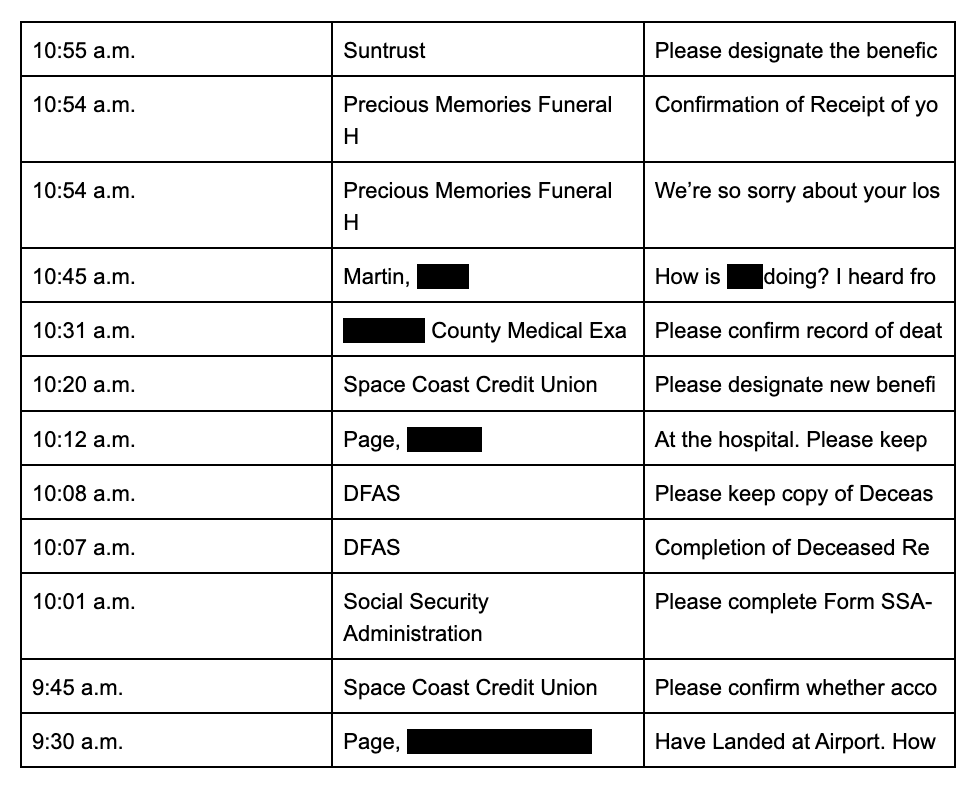
How Quick the Bank Knows You’re Gone. / Thomas Page
Song / Sarah Paley
My sixtieth year has come and gone
I sit, a solitary woman,
In a crowded New York shop
The Times and empty cup
On the marble tabletop.
Tattooed barista, pierced busser
all have my goodwill. I savor
bitterness. They are young.
Simply happy to be amidst, among,
they cannot hear the song I sang. I sung.
Survival Chute / Amy Snodgrass
All week I’ve felt good for nothing
other than a dam for fear,
politely containing it so I don’t quite burst
out of my skin, unbloomed.
With deeds
undone and emotions suppressed, my insides
spin in an under-oxygenated orbit:
no arriving or leaving,
just dreading, reliving.
–a hooded towel in a perpetual swinging spiral, resoaking on repeat–
Misery. But then that moment comes
the one that anyone who knows, knows:
the crescendo of a supposed eternity
bursting like a river blocked-up by boulders
that after all that drama reveal themselves to be mere
cotton balls spilled from the cabinet with the broken door.
With each squish
of my fingers, one swell after another,
then more that slow into drips, I plant myself.
Wiping us the mess, I feel again how hope
crosses its arms, relaxes into the current,
and finds the survival chute, every single time.
January - Poem 23
Home Sweet Hellscape / Haley Bosse
telescoping arrhythmia
from the last infection
extended to the yard,
the grackles
and the crows’ feet
seem to lift
with every frantic thump,
floodwater sloshing
over drowning grass,
erratic without moon-bound tide,
beaks bent
to drink regardless
of the airflow,
its ceaseless pulling
on every upturned face,
the water never
falling still
signal / Jess Bowe
to whistle
to whisper
to hiss.
to make a sound.
to carry a finger across the lips.
to carry love down the sidewalk,
a song unafraid of its fear.
to look a man in the eyes
unshaken and knowing
the blood and laughter you came from.
to slide on the belly and bite
from underneath the rocks.
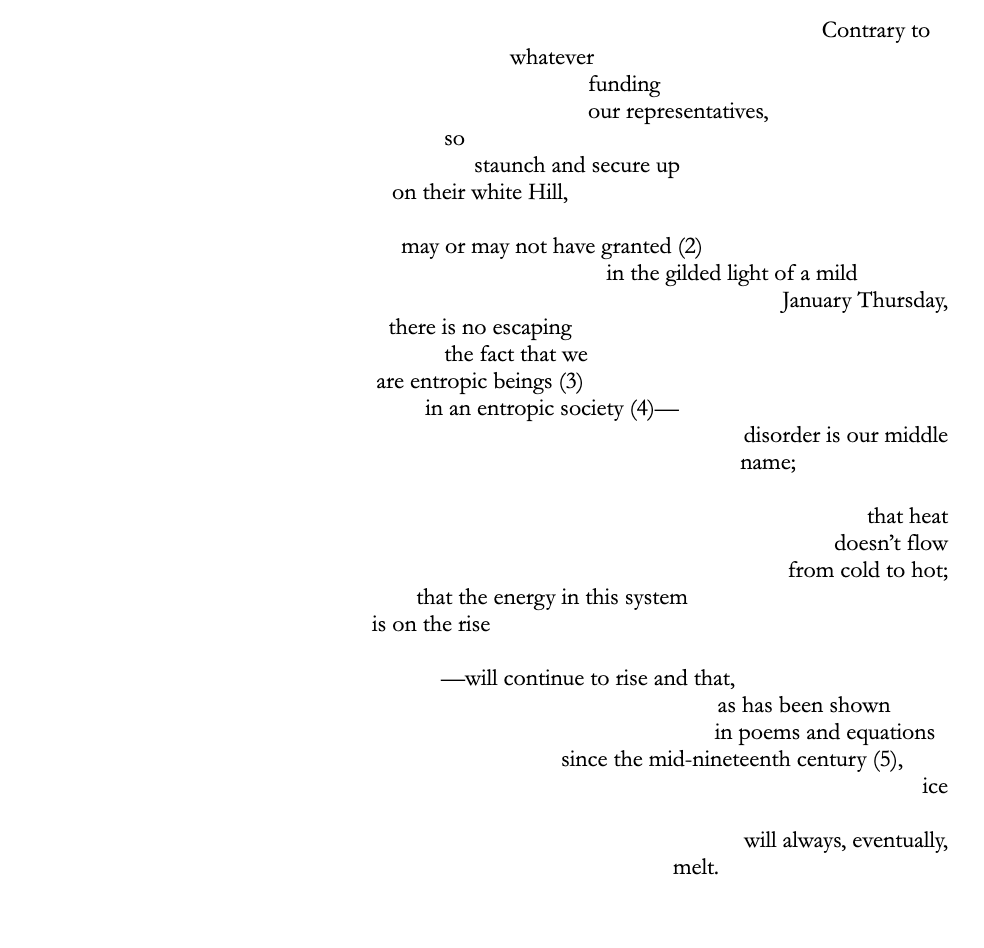
Hope and the Second Law (1) / Joanna Lee
A conceptual, but not mathematically rigorous, summary of the Second Law is that uneven distributions of energy tend to even out over time. This is the result of the combination of chance and the conservation of energy and momentum. It is hard to prove for a general case, but it is easy to posit convincing examples.
To take an example involving kinetic energy, if you fire a fast-moving particle (e.g. a bullet) into a box of slower ones (or a crowd), you have a very uneven initial distribution of energy. Over time, the fast-moving particle will trigger a succession of random collisions in which its excess energy will be lost and the average energy of all the other particles will increase slightly, unless they are killed.
(2) “WASHINGTON – The House of Representatives today passed an appropriations bill that would renew ICE’s excessive budget, with no strings attached, adding to the over $170 billion in taxpayer funds already allocated for immigration enforcement in July 2025.” (aclu.org. January 22, 2026)
(3)In Statistical Physics entropy is defined as
𝑆=𝑘𝐵⋅lnΩ
where Ω is the number of accessible micro-states (6)
(4) To put it another way, entropy (𝑆) is a fundamental property in thermodynamics representing the measure of a system's thermal energy per unit temperature that is unavailable for doing useful work—often interpreted as a measure of disorder or uncertainty. Crowds generally have high entropy compared to individuals, who are usually much more efficient at doing useful work.
(5) In 1850, the German scientist Rudolf Clausius laid the foundation for the second law of thermodynamics by examining the relation between heat transfer and work: Heat can never pass from a colder to a warmer body without some other change, connected therewith, occurring at the same time. E.g., A medic unable to pass through a ring of ICE guards to reach a dying woman’s body.
(6) Minnesota is generally not included as accessible
Family History. / Thomas Page
Please mark in either column the following conditions for any conditions you or a family member have or have had in the past:
Alcoholism / Drug Abuse what can we call excess or just librations
Asthma when the way your lungs feel after a drink
Cancer (please define which) to celebrate the way our cells do decay
Depression / Anxiety / Bipolar / Suicide in the face of the prospect of death
Diabetes (please define which) do you consider the end to be a sweet light
Emphysema a crushing weight on your chest as if
Heart Disease your core is breaking into pieces
High Cholesterol as the fat falls off the bones
Hypertension in a display of immense implosion
Hypothyroidism like a deflated geyser of all the cells
Migraines or a vice wound around the sutures
Strokes cutting all circulation to your mind?
Other (please define which) what do you call that then?
Adult Daughters and Sponges / Sarah Paley
The connection between adult daughters and sponges is tangible.
The adult daughter is not a competent caretaker of a dying mother.
She’d like for her to have a peaceful death. She’d like to fullfill
her role seamlessly, lovingly, patiently and never think about
how daughters and mothers’ relationships are often fraught
and complicated. The adult daughter takes a tiny sponge provided
by the hospice and dips it into water and squeezes it onto
her mother’s dry lips. She hopes that some of the water will
make it down her mother’s slaked throat. People are parched
when they are dying. This is something she didn’t know and she’s
pretty sure her mother didn’t know but now there’s no way to ask
the mother. There’s another sponge, this one larger for “sponge
baths.” It’s an unusually shaped sponge devoid of color. It looks
as if it was plucked out of the sea where it had been alive
and beautiful. When the adult daughter attempts to wash her mother
with this genuine article a nurse officiously takes over. The adult
daughter tries to hide her relief. Was she incompetent on purpose?
Sometimes adult daughters are unable or unwilling to fulfill their roles.
She tidies up the Lazy Boy she’s been living on for the past week
as the nurse finishes her administrations to the adult daughter’s
mother. The nurse comments on the handy hands that made the quilt
the adult daughter is folding, and takes the tiny sponge out of the bowl
of water at the mother’s bedside and throws it in the trash bin. She sees
the look of concern on the adult daughter’s face and says “Don’t worry,
plenty more where that came from.” The adult daughter helps put a new
top sheet on over her disappearing mother. As they tuck in the end,
the nurse, who knows the adult daughter is wondering when this will
all be over, says “I can always tell by their feet. They change color. Look
at her feet from time to time.” The adult daughter nods with gratitude.
The nurse takes a tiny sponge from her pocket and puts it in the daughter’s palm.
She pulls a chair to the bedside, places her hand on her mother’s hand and recites
too loudly:
“The owl and the pussycat went to sea…”
Mentor Text / Amy Snodgrass
after reading Tess Gallagher’s “Now that I am Never Alone”
I admit it: I rolled my eyes
at the title, expecting a cliché,
a well-written whine
about how having kids
interrupts the creative process.
Oh, my lack of faith.
Oh, Tess. I doubted you.
I find no strollers, no nap times,
no pencil-flinging resentment.
Instead: a moth
that clings to tile and rips
to shreds my misplaced cynicism.
You douse my pain with water:
first scalding hot then cold in memory.
Your spring is the tree that roughed my arches to bleed,
your handfuls are the hours of bedside waiting.
I am not sure I can survive your brightest now.
I am not sure I can withstand this raw fluttering.
I am not sure I can write, ever, another word.
January - Poem 22
Winter Movement / Haley Bosse
Tufts of brown fur. The long faces of leaves Thin streams rippling
lifting as they dry. tunneling upward from the crux of a planter
in the sharp thrill of morning & into the air across the sidewalk & into the road
Nearly-foamed snow. The crackCRACK The pop of wet gravel
cradling the roots of oversaturated tree trunks, thrown from a tire,
of the grass popping loose at their seams its soft thump & then rest in the moss
The scuff and stomp Small clusters of cicadas A whistle breaking open
of boots & thick sneakers sleeping or suckling the midafternoon quiet,
dragging in a line at sap far below the startle of running through the cold
short bursts / Jess Bowe
for a moment, i’d like to live in the body
of a woman unafraid to leave for Paris
at the intersection of twilight and daybreak,
leave the yard for someone else to tend to, leave
the man who clings to me at midnight,
temporarily, for a stretch with no clocks
and a window to a street unfamiliar with my name.
for a moment, i’d like to pick blueberries back
when blueberries still grew here. fill my mouth
more than my basket, fill my hands with cups
of grass, bury a poem at the foot of a northern
pine and believe until i know, for a fact,
that next spring, a robin quilts her nest
with ribboned prayers, ink black as winter’s sleep.
for once, as this woman with this shape,
for once, i share my desire with the meadow flowers:
leave me be. let me be beautiful and smile
because i graced the day with a color
you haven’t seen in this way. leave me be and let me
dance in the sun, in love with this little
great adventure i find myself in. alone, surrounded
by strange friends, rainwashed and pink in the face.
Forever home / Joanna Lee
This is where we begin, in the mud with the red-
eared sliders who, in their leisure time,
sun on logs in the canal building a bridge
to nowhere, then slip off into the green
as each slow canalboat passes,
drifting through the past
before hitting the locks.
We know this city through her mud. Through her grit
and mixed politics and potholes and the still
unplanted shadows where statues once stood.
And yet,
from how many little upstairs apartments
do our students make their leaving plans…
then return two summers later because
the bigger world didn’t have that same
gently used, relaxed but stylish fit?
Like the cat at the midtown Lowe’s—we
will always be happy to be found, to return home.
Here chose us, now, our hands to reach for
her future, to dig her bones
out of the dirt
trail our fingers through the cobblestoned
gutters as rain washes down and we sit listening
to some home-grown band through
an open window on a Sunday night.
Listen, who else is gonna argue her history
and picnic in her cemeteries, with a view
out over the James where the sturgeon breach
and the trains coil along the banks like some prehistoric
steampunk black snake?
Those are our cards laid out, graffiti-tagged on the CSX,
bright against the creosote. We trace our names in
the wet tar, claiming. A small piece in the scroll of her archives,
a moment of her river. Our feet in its mud. Our footsteps
that echo all along Kanawha, at the Capitol, up Broad Street.
That will not be washed away.
Bear Documentaries / Thomas Page
While my father and I were waiting for
you to get the stitches taken out, two
receptionists were watching bear documentaries.
The bears, living out west, were hunting for
small mammals drinking river water out
of the stream unaware they were in a bear documentary.
The receptionists’ running commentary
oscillated between stating how cute
the bears were and bemoaning scary nature was.
Coyotes, then, came from over the snowy
hills to scare the bears away from their prey—
much to the chagrin of the two receptionists.
To break up the implied violence shown up
by the waiting room’s ceiling-mounted set,
receptionist #1 said to receptionist #2:
“We have a wild turkey problem at
home but the state of Maryland says we
can’t shoot it.” Receptionist #2 agreed with the absurdity.
Details of the Incident / Sarah Paley
(for Liam Conejo Ramos apprehended after
returning home from his preschool classroom)
You are at the table
and, yes,
you are beautiful
and, yes,
we are ashamed
Sometimes: an Ars Poética / Amy Snodgrass
My daughter ensconces herself in her room
for hours and hours: building her own world,
exploring her own mind, sharing only what,
when, how, she wants to share. A knock can
bring an eye roll, a grunt, a smile, a story.
I never know, but I keep knocking to see.
A poem comes when it comes. Sometimes
I invite one in and it smiles and plays along.
But most of the time it shoves out a snarky
laugh and prefers to stay away. Sometimes
the poem seems annoyed just because I’m
in the room. Sometimes I even wonder if
I’ve lost it for good. You get the connection.
So when a poem pops out like a 15-year-old girl
ready to engage with her mother, swinging a casual
“Whatssup?” and a half-grin-half-smirk, I revel in the
miracle of relief, of capillary-bursting hope, of laughter,
and (did I say relief?) Then sometimes, the poem and my
daughter are in kahoots: each one seeming to find me
a perfect vessel for their woes, a worthy speaker of their
needs, and –dare I say it?–sometimes pretty good at my job.
January - Poem 21
The Song of Potatoes / Haley Bosse
is a gift I never expected to receive,
just like how they say
we’ll hear the birds’ true names
by the end of the winter
and how, even as we wreck her,
the Earth cries out
from countless twisting roots,
the softest crackle of their bodies
transfigured into chimes,
how when I’m dragging
my calluses through the soil,
I can't help but hum,
the cloud of my voice
dissolving in the air.
porch on the moon / Jess Bowe
tethered to rock, gray with waiting,
bone dry, a face on the night –
i see you from the deep sea of space,
imaginary and ghostlike, paper swords,
a plume of worry from the smokestack
of the mind. it’s cold here, a home
diminished and returning. i can almost
feel the golden kiss placed constant
on your blue skin. i can almost feel
the bracket of living you most often
refuse – the ordinary shade of an oak
so familiar, you’ve stopped asking his name;
the seahorse, her three-beat cantor,
salt in her seaweed mane. the orange,
still round on the branch. the subway car,
its endless journey, bottomless pocket
of noise and play and microbial
hands. you must believe it to be small,
your sight heavy with unanswerable
asks of why. you must believe it
a dark and creatured place. i can almost
hear it from here, the bombs you speak
of, fire eating what history can’t save,
licking the streets clean and bare
of anything worth passing to the open
hands of Someday. can you hear
me through the traffic between us?
can you count the stars to my front door?
i see you in heaven; globe of summer
fruit, plump and sweet, promise
at the open mouth of eternity.
Haibun: On the repetition of history / Joanna Lee
Like a funeral procession, a line of police cruisers, sirens mute in the before-dawn, their evenly paced convoy heading south on Chamberlayne, taillights a string of fire as they exit the ramp north into darkness. All week there’s been reports: Short Pump, Chesterfield, Church Hill… now Southside: Hull and Warwick, just down the road. The temperature is falling. Small birds hop in pale twittering circles across the cold cement patio. Behind the counter, the barista waves each patron out the door, on instinct calling be safe more often than see ya round—
like five summers back,
the body remembering
a same swoop-sick fear
An Erasure of an Erased Message from March 2020 / Thomas Page
I wanted to update you with what is happening with Ari. Mom and I went with her to the Howard County Medical Center after she had called mom. They requested an ambulance and she was taken to Johns Hopkins in Baltimore. They think it’s Leukemia. It’s what they feared. Mom is really stressing now. Can you drive Ari’s car from the Howard County parking lot? Mom also wants you to buy some gifts for dad’s birthday. Maybe giftcards? She wants you to do it before the quarantine. She’s on the phone with dad now. How is your meeting going? What time can you leave work? Mom said that you said that you asked for a sub for your meeting. I don’t feel well myself.
Cherry Picking in Pasa Robles 1945 / Sarah Paley
You look pretty up on the ladder
in your capri dungarees – your bobby
socks slumped down around your sneakers.
The night before, you tied one on, danced
in the dusty streets and shouted
at the locals about how you hated
their western town, their hick ways.
Now you’re feeling different surrounded
by the branches heavy with fruit. You
hand the baskets down to men who have
done this work before. You, you’re just broke
and out on a lark. Years from now you’ll grab
a tiny plastic saber and stab a maraschino cherry
out of a cocktail glass and declare: I picked that!
Dusty Learns to Drink Water / Amy Snodgrass
Something I didn't know: newborn kittens don’t know how to drink. I found him,
discarded, holding on, in a plastic bag, in an empty lot, under a warm drizzling rain.
We built a strange partnership: six weeks of every-two-hour feedings, droppers,
formula, warmth. Time passes, of course, and now, somehow, it is time to wean.
Another thing I didn’t know: kittens prefer to drink from wide and flat receptacles,
not bowls. I set out a wide, flat green plate, a field for his new and necessary adventure.
Thirst, and instinct, and no mother but me: so gigantic and strange. He has to teach himself.
At the first wet touch on the tip of his nose, he starts and shakes and sneezes, hopping back
like a frog in reverse. Mini-splashes ripple again and again. I tire before he does and so,
distracted, I miss the moment, damn it. I miss his choice to stay and see what happens
if he doesn’t start or shake. I miss his determined overcoming. By the end of the day
he has it: lapping. I stare, awash with regret and awe. Just this morning he still had to learn.
Just this morning he didn’t know. Just this morning he depended on me. It is hard
to remember now, the not-drinking. It seems as if he had always done it, as if his mother
had taught him, as if that plastic bag were being used to wrap a sandwich
somewhere else instead, as if the confusions of the past never existed.
But they did, and they do, and they will: as essential and mysterious as weaning, as water.
January - Poem 20
Other Fairies / Haley Bosse
You were born in a year
of lesser fires
and unrung quakes.
The worst you faced
were children sick around you
and then, of course,
a fever of your own.
We lay curled
and sweat-stuck
into blankets.
When the rain started or
when the rain stopped,
we pulled ourselves up
to learn its dance.
Look, the moon said,
and there we were.
good on paper / Jess Bowe
some people don’t try hard enough when it’s hard,
i’ve heard. some people make rash decisions.
some people don’t let the lovemaking heal them
after the last fight. there’s a folded packet
of paper in my old bag, sitting on my closet
shelf. i never asked what to do with it, so i kept
it at the bottom of the dark. i wonder what home
we’d have today. we'd probably fight about the elk
antlers. they don’t belong in the living room.
you’d probably be asleep on the couch after work.
your brother would still hate me. i’d still
be counting minutes into the morning
for the booze to lift and the beer to wash
itself out of my hallways. somewhere inside
of us are two kids: one listening to you read,
one laying on my bedroom floor after the funeral.
Poem I write while packing up the Christmas tree ornaments / Joanna Lee
I did not mean to be thinking of you.
I was just stealing a few minutes
before dinner to tuck
your little glass angels
into their bubble wrap sleeves,
stack the crystal-and-gold snow-
flakes precisely one atop the other.
And yet here we are, the ghost
of your cigarette smoke
staining the bottom of each box
like cheap fingernail polish, a yellow
memory.
Funny, I can see you
in your red sweater, arm
over the back of the couch,
the cigarette in your hand.
I have heard your voice on repeat
in my dreams, and one cold clear day,
it emerged out of my own lungs
when another car collided lightly
with mine. But I cannot see you
take the smoke into your body.
Not remember how you must
have lifted it to your lips.
Only hear the cough—a wound
of gravel and gauze born
far from the ocean & which leaves me
imagining that last hospital night,
what it must
have felt like finally to run
out of breath,
and no one listening.
I did not mean to be thinking of you.
You, too, always hated this job.
Embrace / Thomas Page
The doctor left you in the room in tears
saying that if all else fails in the dead
of night that it would be the sum of fears
that if you were to die that night in bed
then it wouldn’t be a surprise, he said
in a manner so clinical you froze
thinking of everything inside your head—
I remember how long you held me close.
You turned to me when the shock loosened gears
turned in your head. Take your brother, you pled,
home so you all can sleep in our home years
settled in the dirt. Your face was all red
holding back the severity that spread
deep in your eyes trying to not wet throes
as our own hearts were beginning to shred—
I remember how long you held me close
Gingerly walking over to you with spears
in my gut, knelt down to embrace you stead-
fastly, you whispered soft prayers in my ears,
your arms trying to cleave cleanly with thread
me to you that I could maybe have led
you away from all of the rubble those
realities piping wet poisoned lead—
I remember how long you held me close
O princely doctors, whose words sharp as sheers
upon a precipice they don’t mince prose
the way you cut briar roses with shears—
I remember how long you held me close.
Summer Blagoveshchenck, 1828 / Sarah Paley
(mistranslation after Pushkin)
Calico cats, centipedes, monkeying goats, dog,
NOT funny, humble bumblebees taking
their morning prambles and blitzing Bluebells & anything
NOT red. The thrush plays harp strings –
B to not so minor C to B because he likes a timeline
yet tomorrow’s hero trills
B crescendoing to a howl that resembles the express
from Tiadavostock to Irtusk
Screaming through fields of cabbage and barley. Tick-tock,
station masters shapes appear and mock...
ButImissmyplace! Six months ago none of this
could happen but the passing seconds...
No, not C! Anything but C in any key. Mellow
a penalty not spoken
No, I’ll repeat for the silent spider, no kangaroos can
hop de hop near this clamor.
Hope / Amy Snodgrass
(Thank you, Carolyn Herman, for the prompt!)
Things I both love and hate:
speed bumps
Ziploc bags
saddles
lorazepam
K-cup coffee makers
calluses on my toes
wind
Things I only love:
those birds passing overhead, looking like petals swept up in a dance
this close silence tempered just enough by distant monkeys howling
the constellation of freckles on my daughter's cheek
an assuaging of my fears by any means
all the chances I get to leap, literally or figuratively, with my son
light reflected in water
a horse’s forelock
Things I only hate:
Plenty, but I will give them no platform here.
How wonderful, wonderful, to re-invent ourselves.
You can always stand up, even if everyone knows you as a coward.
You can (of course!) begin to flood the world with kindness even if
you have been known (for years!) as the bitch.
You can choose to assuage someone’s fears (mine, if you like) rather
than stoke them.
Listen.
Ride bareback.
Go barefoot.
Buy a glass French press.
Curl into the skirt of a sequoia until the gusts soften into breeze.
Invest in a Bento box and forgive yourself for the rest. How wonderful, wonderful. Wonderful, and just right.
January - Poem 19
Doom Scrolling / Haley Bosse
How many hours of the day am I supposed
to let the soft animal of my body
smash itself against the world? How
does anyone survive more than a single moment
of wet sparks searing across the folding of their brain?
Today, I watched a shrimp search through its horde of tiny stones,
taking each into its mouth and sucking quickly before letting
what couldn’t serve it fall away. Look, I said,
I can even see its heart, searched,
Do shrimp have skin or cartilage or something
else protecting them? Some days, I don’t remember to fear
how much I haven’t seen.
every dream i can remember / Jess Bowe
women washing hats at the stream
at the stone wall, lining hats
in the sunlight, lining men’s
hats in the morning, hats bathed
in river water, hats brimming
and stacked in the morning of war.
tunnels in and out of small white
houses, village tunnels, tunnels
built by women, mapped by mothers,
guarded by traditions of secrets,
elders at the mouth and door
of each tunnel, mountainous hallways,
mud and plastered tunnels, voices
carried, final note of the root
generation kisses the head of each
first note carried through the tunnel
like blood like blood like blood
through the body.
see them from here, top of the hill,
see them from here, dirtied foreign lights,
see them from here, out of sight,
see them from here, no distance
is a safe one, no silence is a favor,
no quiet is without sound,
cars and bodies perpendicular
marking lines of ruin across the map.
the safest place is with each other.
the safest place is with a woman.
the safest place is a covered crown.
the safest place is a tunnel
of mothers and grandmothers
carrying ahead of us torches
and stories our mouths
keep swollen and armored.
North with the wind in the left eye / Joanna Lee
--for Aloka, the Peace Dog, on a successful recovery
toenails click
weary miles
velvet paws
threadbare
asphalt
longings
heart tattoo
quiet
find the path
never lost
furled wagging
to spring
opening
purple tulips
in January—
namaste.
Commiserate / Thomas Page
You’d think that
you’re
the only person on
Earth who has to deal
with the unbearable, crushing weight of another person entire existence
on your
shoulders like the beleaguered Atlas groaning
when the world asked him
to turn winters
into the summers of youth.
You’d think that this is a brand new
experience—a vision of your eternal torment for one sin
like the vole pierced by the shrike
who dared to venture out into the clear day—
pierce your heart
whenever they
ask how you
are doing dealing with everything that is heaped
onto your worn shoulders—
a cynocephalic saint in river water.
You’d think
that you’re as alone as hermits
chasing away golden demons
or silvery promises
whenever you pray
for times like these to evaporate like smoke
from steaming thuribles
swayed slowly
in a rubricked, Roman rite that you
never wish to hear their name as the intention.
You’d think that you say
and drive
far away to a desert resort and sleep
all day in the stale, airless hotel room
and order all day
margaritas
too watery, too full of salt, and too expensive
to justify this personal time to yourself
later.
You’d think that you could sometimes
sleep in after the morning glories open up fully
and birds roost
before the world realizes you’re not dead and buried
able to wash dishes, plates, cups, spoons, and forks
and clean toilets
that are somehow pulpier they were
the night before when you
said
You’d think that you’d be
appreciated for all the work you do around here
especially since
has decided for the both of you that they’re
too busy to help out with the care of
the only one y’all
have left in this cruel world that gave y’all
only two to care
for your whole lives.
You’d think that you’d never
be understood by the rest of the world
because it’s
and expected but never really talked about
in polite society because it’s a downer
to talk about terminal care with those who avoid
their
loved ones who are suffering
before their very eyes.
Sloth / Sarah Paley
Let us now turn our attention to the Sloth
who lives and dies in the trees.
Let us do justice to him.
He is scarce, solitary.
He inhabits remote and gloomy forests
surrounded by snakes.
His neighbors cruel ants and scorpions,
below him swamps and thorny shrubs.
He has no soles on his feet – none.
His countenance wormwood.
Does he ask for our pity?
If he knew our thoughts
he would outstretch his arm.
anxiety / attack / Amy Snodgrass
what what / to Xanax or not to Xanax / what what / coming on / from an inner realm of blood / a volcano or a wave pool / or something else–it’s me, right?–that begins with an unseen shift / a subtle rumble / tumbles then shakes something loose / something / what what / is wrong with me / I’m scared / what what / to know / to not know / spoon crashes / ringing in my ears / silence ringing no / silence bouncing off membranes / sending that shudder / its neuron push / and go / what what / and go on / do it / remember / standing there by the bench / by the Charles / then again / under the Bluff Park overpass grasping the chainlink / walk walk away / pounding the road / walk walk / fall / curling on the kitchen floor / just a two-liter Sprite / what what / cool tile / for days / yeah but Susan Sontag / and Lorelai Gilmore / and Joan Didion with her migraines / all get me and that’s / what what / I need / to feel ok / when I get the what whats / what what please just / get me
January - Poem 18
On the Brightness of Pain / Haley Bosse
Like a peach pit rattling loose
In your pocket, overalls
Several days unwashed, wet
From creek forging
And sweat soaking, perpetually
Drying and re-soaking,
Silk of saturated skin rubbing
Raw on the split seems,
Fingers curled into rough tools,
Face tilting in the blister
Of the sunlight, cloud bursting,
Break in the trees biting
At the roots of your eyeballs,
Sharp creak and rustling,
Every call of an animal,
Much too small and alive.
sadie / Jess Bowe
i’ve read that circles
don’t exist to perfection
in form, yet you, held
up to be seen, first
light of my eyes — new round face
a slow-blinking sun.
mathematical
equation pulled from stardust,
i’d sit with you, glass
between hand and Love.
seventeen days of praying
for air to fill you.
i laugh at infinity,
electric beneath your hair.
Not pictured in this image / Joanna Lee
How through the long afternoon we sit
in a back booth at our favorite Mexican joint holding our eyes
against the little vestibule that serves as entryway.
We head out only as the daylight burns itself off,
turning our noses to the sky, the wet smoke of snow
maybe to come, the prayers traced on our breaths reaching
out into the young night like slight child’s fingers—afraid
of what the darkness touches, eager
to find a solid door between it and home.
When they don’t know what “terminal” means / Thomas Page
Reviewed test results with patient // & diagnoses // & care plan // & new medications // asked patient what his preferred pharmacy was // he nodded // explained that the dosage would upped // based on the recommendation // of the cardiologist // he nodded // asked if his living will was up-to-date // he nodded // patient asked if he needed a referral // I explained that the surgeon would probably not do the procedure // due to his age // & risks // & potential complications // he nodded // said that he also thought // that it wasn’t necessary // asked if he had chosen a proxy yet // he nodded // said that his eldest had volunteered // to make any decisions regarding that // that she had asked him // to outfit his house // with ramps // & said // no // I’ll be fine // asked if he had any final questions // he nodded // & said // no // I’ll be fine
Five Ones / Sarah Paley
When it’s cold we wear long johns
and over them snow suits.
Thus padded we have trouble moving.
There is comfort
and discomfort in it.
We step like astronauts out in the snow, crunch through the crust
and sink into the soft stuff below. We. make our ways to the bank
of the Mohawk River, breaking the pristine plateau into one path
with two narrow gullies – five left feet in one,
five right feet in the other.
One will be sent out as a probe on to the ice. If safe, one will go ahead
with a shovel creating corridors that form a giant maze.
Two are instantly graceful – one stumbles,
one assumes a racer’s stance,
one pops an imaginary starter’s pistol.
If there is wind we unfold the old sheets carried under our bulky arms,
one grabs the top and bottom corner, the other one the opposite corners. We stretch
our arms wide and make sails – catching gusts
to propel us to the big island
and beyond.
Four = two human ice boats.
One chases after them, gives up
and makes
circles
ever
widening.
The Smoke of the Copal / Amy Snodgrass
after Jim Simmerman’s Twenty Little Poetry Projects
The howler monkeys can be heard over the sound bath tonight: my former lives
swinging back around. I isolate the sounds perfectly and pour each one
into its own glass beaker. I smell hope in the smoke of the copal and watch
its wisps spiral. The mint I unwrapped in the car lingers on my tongue.
The beads on the pillow given to me look lovely but feel rough and pull my
hair like taffy if taffy carried a syringe. I taste the prick and flinch. Francis next
to me catches my eyes in question but the rules of La Senda are clear: silence,
introspection, eye closed. I smell despair in the copal and watch its wisps come
at me in revenge. For what, I don’t know, but I think one of the monkeys
could clock it. I need to find the right one since our dinner depends on it.
Quero uma garrafa de água gelada. The sparkling beakers of promise sit
in a line filled with my past. One could chug them like poison but this is
not that kind of story. Instead I latch onto the smoke of the copal and wisp
my way out of the dome. No one notices la chintanita is gone, because
of the rules. All eyes will remain shut, all souls will keep introspect, all
voices will continue in silence. The promisingly predictive monkeys watch
my swirling self approach. (Do not believe any of most of these lines.)
The trees absorb me before I even come close to the howlers. “They
have moved on,” the trees say. “Let them go. The revenge was a mirage.
You have come so far to become it and it is no longer. Look ahead,
walk on.” Back on my blue and beaded pillow, I smell love in the smoke
of the copal. The beakers have been tilted and spilt by unseen paws.
January - Poem 17
On Staying / Haley Bosse
Today, the poem
is just waking up.
Just now, the poem
crossed the bank
at the end
of the night.
For a breath,
the poem is not
a pole
through the stomach
of the roadside
or the shadows
hunting mice
through the wet wheels
on the asphalt.
The poem only traces
light beams, unending
through the fog and
today, you are still
the poem
and no one
has to sing.
to dwell: a found poem / Jess Bowe
with lines drawn from Where Two Worlds Meet — Janet Nohavec
break the sound–
bells, rain, waves.
between breaths,
climb inside
the air.
house every detail
you can hold.
Dear Abby / Joanna Lee
--to Abigail Spanberger on the day of her inauguration
I work across the river from the Governor’s Mansion, where the jet engines and cannon fire are hardly noticeable over the noise of customer chatter and espresso grind. Parade or no, the James keeps rolling along to the same quiet questions, people are dying just crossing the street, ICE is shacked up at a hotel down in Midlo, and the country as a whole is the scariest place I’ve ever been. Day over day, time stitches its quick way through our hands. They are coming. The signal fires are lit. So, what I want to know is this: hypothetically speaking, if you were the first woman governor of a blue state in a nation barely holding itself together, would you bar the door between a stranger and the night, a shield for the disappeared? Would you fight the fear of silence with the last breath of a mother’s ribcage? Would you cross the river, for me, stand shoulder to shoulder as thunder breaks and the banks rise and dawn rises in doubt?
Asking for a friend.
---RAINED ON IN RICHMOND
When they don’t know what “hospice” means / Thomas Page
The patient’s family nodded when I reviewed hospice protocols // they seemed satisfied with the care that we were going to provide // patient’s daughter asked for more acetaminophen for the patient // told patient’s daughter that he was already prescribed aspirin by Dr.— // & that patient had received 325 mg with meal // asked patient if he wanted to see the chaplain // patient asked for a priest // explained that the catholic chaplain is only chaplain // Fr.— does his rounds on thursdays // suggested that daughter call patient’s local parish today // she scribbled down a number for the parish on a napkin // & asked how often I would be checking in on patient // explained that nurses come around as much as possible // & that what we focused most on was making patient comfortable // patient asked me to open window // so that he could feel the air waft in // patient’s daughter asked me when patient was expected to be released
My Mother’s Decisive Assertion / Sarah Paley
I assert most decidedly that I am dead.
You may hear my voice on your phone.
Though I am not there, only in your head.
You may see me in gestures or something you read –
be jolted by my presence in your bottle of wine.
I assert most decidedly that I am dead.
Shopping for your son you stop to look at a bunkbed
that he’s too old for. It’s just the one I had in mind,
though I’m not there, only in your head.
When you talk to yourself is it your voice or something I said?
Never mind, who cares? Except for you and me, no one.
I assert most decidedly that I am dead.
Inscribed title pages, carrots, otters, vodka, sea gulls,
locks the kind that let water in and out not the kind
with keys. I’m not there, only in your head.
Give me the benefit of the doubt, the break I need.
I will not call, I will not write, I will be gone
and I insist most decidedly that I am dead –
it’s only you. Still, I am there, in your head.
after all the unbearable footage / Amy Snodgrass
unsure how I can write
a poem tonight I’m too
afraid
anxiety eludes
metaphor
but metaphor
chases stomach gliding the ground
anxiety begins
from a regenerating and
shifting/shifty center
it begins on a frozen and evil-strewn street swarming
it becomes an unheard-of snake writhing in
me unseen
from the inside pressing out
on my blood
on my breath
it coils up many-tailed
one wraps
my throat sharp aloft
another nudges my right
hand
in gentle fury
a double agent it hisses
wriiiitte
January - Poem 16
A Maybe Ode to the Lips Mouthing Along to Protesters’ Chants / Haley Bosse
But no ode to the officer.
No odes to joining what has been shown
Again and again and again
And again and again and again
To want to kill my neighbors.
So ode to the police officer’s neighbors,
Who are also my neighbors.
Ode to their tears, watching
Masked men take our neighbors.
Ode to the dream where
My neighbors bring back
Our missing neighbors. Ode
To nights where no death
Steals the dreams of my neighbors,
Though we don’t get many
Anymore, calm nights
Where my neighbors
Walk slow through the clouds
Of warm jasmine lifting
From the trellis of our neighbors,
Nights where anything seems possible
Or at least present,
All of us breathing
Wherever we are and not
Being suffocated or shot
Or stolen by men who hide
Their faces. When I still dream,
My neighbors all have faces,
Though I’ve been told
That it’s not possible
To imagine anyone I haven’t met,
To love anyone I don’t know.
I don’t know
How many of my neighbors
Have been taken. I don’t know
How they’re being harmed
Behind fences and walls and beyond
The reach of cameras as I sit awake
All through the night and don’t dream.
I am awake and awake and awake
And awake and awake and awake
And my neighbors are not here.
and also / Jess Bowe
i am here. blue sheets. two
windows. baby, asleep. dog
rearranging on the downstairs
couch. night moving further
in to the center of my circling
thoughts. i am here, and also
in the part of an ocean i can’t name
where hands turn to nothing
and humans go from god to shell.
whalesong is caught by a cave
untouched, held deep in the jaw
of the earth. i am here, and also
in the streets on a road
where a father taught his son
to balance without caution
where a father taught his son
to make friends with every fall,
is the sound of birds
and no bird to be seen,
brick to brick to brick
the bounce of a whistle
trills a long night ahead.
i am here, and also
i can’t bring myself
anywhere but places
that appear to be drowning
in deep water,
swimming with sharks.
somewhere in the mouth
of the Dark emerges
language, ancient, stitched
across the belly of sleep.
Point of Entry / Joanna Lee
I’ve only once been to Minnesota.
A medical school interview,
an ancient history. Early December,
snow falling for the first time.
The light of it, slightly pink in the dusk,
flakes like thousands of tiny God fingers
brushing down on a hard planet.
The hospital parking lot fluorescing
pools of warmth, a familiarity.
We know each other, it said. Be welcome here.
So quiet, you forgot to be afraid.
Goosebumps of hope like only the young get.
So much wonder between that moment
and this, God taking the snowglobe
of their grand experiment
and giving it a good shake, and now
you can’t look away /you can’t not
write about it, even at such a distance,
so many unknowns: the slickness of time, its trembling
recitations of history and promise—
What if I had been there still?
What if it had been you
waiting at the door, boots on the mat?
What if it hadn’t been snowing,
no God fingers, no ice?
What good could we have done/can
we do/what good is a poem anyway
against batons, rubber bullets?
Knight-Errant / Thomas Page
A knight errant; his own wandering page
must take ahold of his blades and sabers
when he goes to fight the wyvern. Some sage
words of remainders bound the page’s labors
to tarry over yonder to neighbor-
lands in a quarry for some forgotten
symbols of battle; cymbal or tabor
rallying the knights in indigo’d cotton
dyed with oxidized blood running rotten
down their sides; a mimicry of their Lord;
passion to strip the old world of jotun.
A page comes to his old knight’s body gored.
A knight errant whispers blood in his beard:
“It is everything that I have e’er feared.”
Litany / Sarah Paley
The other day I was telling my son about an order of monks who lived circa 600 AD who catalogued and ranked everything. Everything on earth and in heaven, They’d sit at their tall desk and arrange and rearrange their lists all day, every day.
Seraphim,
cherubs,
treetops,
bird’s nests,
green…
and so on. All the way down to
toothworm,
toenail,
maggot
plague
As I explained my son interrupted: “That is the perfect job for you.” He’s right
but what he doesn’t know is I’ve been at it all my life. I start upon waking and go
till sleep. Sometimes even while I sleep.
Just now,
a man pushing a dog in a baby carriage
This job of mine has no end. No one gave it to me. Judge, place, sort, Judge, place,
sort.
leaf of a scarlet oak
older gentleman tenderly holding his wife’s elbow
the whorl of pigeons above the steeple
a sharpened pencil,
the lone hellebore on 10 th street
man asleep on sidewalk with no shoes
coffee cup lids
stickers on fruit
my attitude
a sudden memory of his/her death
ICE agents dragging a woman from her car
famine
war….
It doesn’t have to be done but it’s done.
The Antecedent of It is Grief / Amy Snodgrass
Take it with you when you ride.
Rub it into your saddle to condition and protect.
Then let your sweat and the rainwater dissolve
it over time and carry it far away to the sea.
Let it, as you paint a snail, become the yellow you dab
onto the antennae, creating the reflected light you
see when you remember her hands. It will live there
on the page, holding her in place in golden drops.
Let it, as you draft in your notebook, be teenytiny
letters, written for fun, to see if you can
read them later: like a code, private just for you.
Let it, as you stand in her kitchen, flow through
your cracks like olive oil through penne, softening
and loosening them for all that will come.
Let it laugh at that penne metaphor.
You know she would laugh, too. Hear her.
Please: turn those tiny messages and pasta metaphors
into poems. Believe you have a gift worth giving.
Let it be that belief. They have the same ending anyway.
But mostly, as you hike every year up her bluegreen hill,
let it be in every tree you pass: in the bark and in the roots, in the
pine cones and the sap, in the glowing char from a controlled fire.
January - Poem 15
living ghosts / Jess Bowe
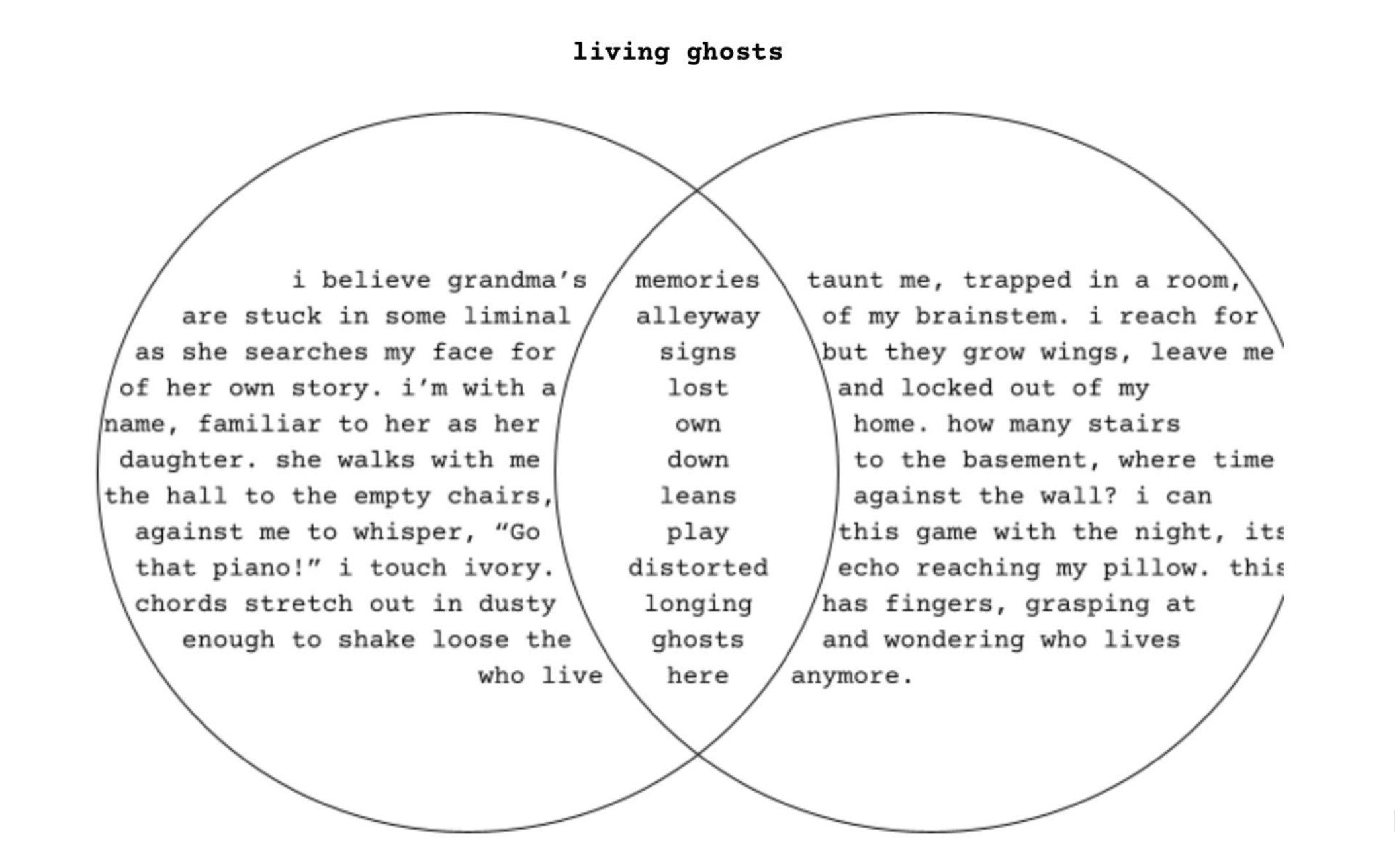
Tolerance / Joanna Lee
Sirens
were once
bird-bodied
women if you
believe the old
myths, their echo-wail
through the nightwash
breaking darkness into
startled shards, luring
us too close
to the rocks. In this
instance they are distant—
a black train through
a black tunnel, headed
south, the sound waves
receding or
a tide going out:
someone somewhere
dying, but not
any neighbors
we know.
No one
is tying us
to the masts
plugging our ears.
Nowadays
they’re more a track
in our shuffled
trauma
playlist that comes up
at least once
a day, a reflexive
audible Father,
Son, Holy Ghost, white
noise colored
red. Someone
somewhere is dying,
but a fortnight
into the new year
and this city
has of yet no
reported homicides.
That has to mean something
right? In the cold
stillness of pre-dawn,
the streetlight beside
the vape shop’s
dumpster holds
the light
of a north star.
A Funny Thing Happened on the Way to Your Celebration of Life / Thomas Page
You always reminded me to cut my lines
like the plaque away from my teeth but I was bad
at making a metaphor feel short. Regardless,
I wanted to write about when I was driving
to your Celebration of Life when I saw
a red Camry that had pulled into the left
lane to turn onto Lynn from Gunn Highway.
In the back, with his face pressed against
the window was a child staring intently
at me as I drove past. When we made eye-
contact, the child lifted his hand with
his middle finger pressed against the glass
and sneered at me. Sneered at me, an innocent
man just driving to a celebration of life.
What had I and my dirty silver Focus
done to this nine-year-old child to make
a crude reference to pheasant under glass?
After I drove past, I was miffed at first then
laughed at the absurdity of it all.
Courage / Sarah Paley
Harold Smith, the elevator operator
lets the daughters of the dead tenant
formerly in 2A pray out in the corridor
in front of the deceased’s apartment.
“I’m gonna have to tell them they can’t no
more at some point.” he says. “It’s kind of creepy
but it makes them feel better…” Marco
the Super isn’t aware. “Oh, man, if he
finds out...” Harold doesn’t finish the thought.
He shakes the Super out of his head: “You ever
meet Mickey Rooney?... No? I did. He bought
suits from my father’s store.” He adjusts the lever.
The wooden box he has manned for thirty years
opens. “Nice guy.” Sunlight and interlopers appear.
Fussing about in the Branches / Amy Snodgrass
after Jimmy Santiago Baca
8:15pm: I am still awake thanks only
to the testosterone pellet inserted in my side.
The incision itches but I have more
pep in my step, and I am glad for it.
Stretched out here on my gray couch,
I allow my arched thickness to send me
on its favorite ride: the Pride-Shame roller
coaster. Cresting the first hill, I gaze at my
children’s art on the wall across the room.
Pop! A wolf howls! A snake meant to be eating its own
tail escapes that fate (Seemingly a miracle, this saving of
a life more likely happened because of underdeveloped
spatial awareness.) and an elephant trumpets a stream
of confetti back over itself onto a triangle holding three
balloons, all representing, in my hopeful mind, two
childhoods going well. Happy.
I wear my menopause–loony and beautiful–like a lined
and woolen cloak. I am equal parts 1) sunk under its weight
and 2) enthralled with swinging it out and around like
a detective, superhero, knight, magician. I can be anyone
I want now!
I still have to check my son on the tracking app, though,
to make sure he’ll be home by 9. And my daughter will
pop out at any minute—I hope I hope I hope—with a story
and a plan.
But me? I am being reborn: howling whenever I want,
dancing under fantastic elephant confetti, no longer eating
my tail. Who knew? Who knew, all that time I thought
my children were doing art projects to develop their
creativity and their prefrontal cortexes when all along,
they were actually building my future, handing it to me
on a canvas, setting it on a shelf next to a broken vase
and a rusted horseshoe, open side up.
January - Poem 14
One More Ride Home from School Together / Haley Bosse
I’ve realized why we’re here.
Let your forehead freckle,
rumple of something
I am too afraid to prick.
How do you feel
about this thing of darkness
a minute astride?
The scampering heart,
the hitch in the night.
Come and look.
We passed your family
waiting at home.
Little not-bird,
even beyond,
you have to learn how to swim.
I must stop here.
Words scavenged from Charlie Mackesy, Lidia Yuknavitch, Liz Robbins, Kai Cheng Thom, Monica Ojeda, Emma Jones, Christopher Tang, and Shelley Thomas.
a war of one kind / Jess Bowe
tendrils in the back
is what the shaman told me.
like an octopus.
but surely not as
wise, an animal like him.
surely not as kind.
my insides spiral.
i am every woman with
a blade in her womb,
bleeding on the skirts
of history, silenced as a
sniper on the roof.
we are the weapon, our mouths
of grenades and poetry.
Every six months / Joanna Lee
In the elevator of the cancer center parking garage,
a red-haired woman across from us
is giving me the once-over:
with puffy coat & chunky-
heeled boots hiding my mini-dress,
i’m the giraffe in a candy store
holding your hand while we stalk through security
and to the next set of elevators,
only to sit & sit in a darkening waiting room.
one thirty-nine over seventy-eight.
your blood pressure before they stick
the tube with the camera up your nose & down
your throat. my eyes slide
between the screen and your face
as if i could catch one of them lying, admitting pain.
your vocal cords a half-frozen glossy pink horseshoe
on the monitor, your voice remembering old scars,
the doctor’s arms relaxing as he leans back
against the counter: nothing new.
this time, you do not use the pocketknife
in your glovebox to cut off the hospital ID.
on the way over the bridge, stuck in a line
of taillights like a river of fire so i’ll never
make my six o’clock poetry event, you
remark instead on the sunset.
we both look up out the windshield
at the deepening blues, crimson-
streaked, something to see.
Valiant Air Command Warbird Museum / Thomas Page
we all went down after the snowbirds re-
turned to the great outdoors where alliga-
tors and egrets gather in communion
in the cool, salty air of januar-
y. all stuffed in a minivan without
coats or sweaters, when we arrived at the
museum i remember how quickly you’d
went to the ticket counter making sure
that we’d all be able to look at the
warbirds in the hangars. the air was cold-
er inside of the metal cage holding
these birds that, according to your tour, were
used to the balmy airs far out west when
you flew helicopters. the sterile, gray
concrete nearly camouflaged the arti-
facts held down by chains and breaks you asked to
have the curator to open the ca-
bin doors so that we all could see inside.
Metamorphosis / Sarah Paley
Black rocks slick with slimy green, I re-call
and grey scummy soap suds floating back
and forth over us. So many yesterdays
but they flash involuntarily and bid
me to acknowledge a sense of time
and chronicle as it’s not possible to return.
If I could know what I do now I’d return.
I’d return to eat the sunken cala
lily – my first meal- oh so good. And that time
Ann and Adrianne and I ate the Brush-back
algae and got drunk on the turbid
stuff. We couldn’t tell today from yesterday.
From above our watery ceiling we heard: “Yesterday
when I was young…” A song about a man’s return
to his youthful dreams. Ann said it made her li-BID-o
sing. Li-What? We didn’t even know to call
a song a song but suddenly we were off. Back
Street Boys boomed from a dock and Time
after Time made Adrianne cry every time.
We swam in circles and listened to it on days
they played it off the boats above. Back
then three polly-wogs who didn’t return
to the shallows were presumed eaten and called
fish sticks. We’d show up, our tails shorter and bid
them goodnight or good morning. We three bid
one another with wishes for a longer time
together. Adrianne sprouted legs first. We called
after her as she crawled ashore. We backed
away and watched. Then I too couldn’t return,
couldn’t stop the changes. No more yesterdays,
not the ones we knew. And now the yesterdays
are everywhere I look. Rivet, rivet I bid
thee the farewell I didn’t get to return
to say. Changes happen – nothing time
can stop though I can’t stop looking back.
Polly wolly doodle. Any requests? Last call.
Call back yesterday, bid time return.
Letting Go of Grief / Amy Snodgrass
You glide across the overgrown, root-filled hill.
Cell phones meant to light the way distort you,
make you enormous, looming to the arching attics
in wavy shifting layers, reminding your daughter–
barefoot behind you–of her anime, ominous and dark:
“Let’s watch together when we get home. Promise?”
Your mother’s absence hovers, sends tendrils that trail
wisp-like into your bloodstream, attacking from all sides.
But still and of course you promise.
You gaze up as canopy arms spread and Orion rises.
Later, home: sand-and-salt-filled clothes
in the washing machine, you fulfill your
promise, fraught with prophecy and fire.
You hold her elbow in the cup of your palm.
She crumbles softly into sleep. As you shake
a gray sheet out over her, you decide. You put
your clothes in the dryer. You will shrink that
titan-sized shadow into one small glowing square.
And later, as she rests, you will fold it and store it,
high up and away.