
January - Poem 23
Home Sweet Hellscape / Haley Bosse
telescoping arrhythmia
from the last infection
extended to the yard,
the grackles
and the crows’ feet
seem to lift
with every frantic thump,
floodwater sloshing
over drowning grass,
erratic without moon-bound tide,
beaks bent
to drink regardless
of the airflow,
its ceaseless pulling
on every upturned face,
the water never
falling still
signal / Jess Bowe
to whistle
to whisper
to hiss.
to make a sound.
to carry a finger across the lips.
to carry love down the sidewalk,
a song unafraid of its fear.
to look a man in the eyes
unshaken and knowing
the blood and laughter you came from.
to slide on the belly and bite
from underneath the rocks.
Hope and the Second Law (1) / Joanna Lee
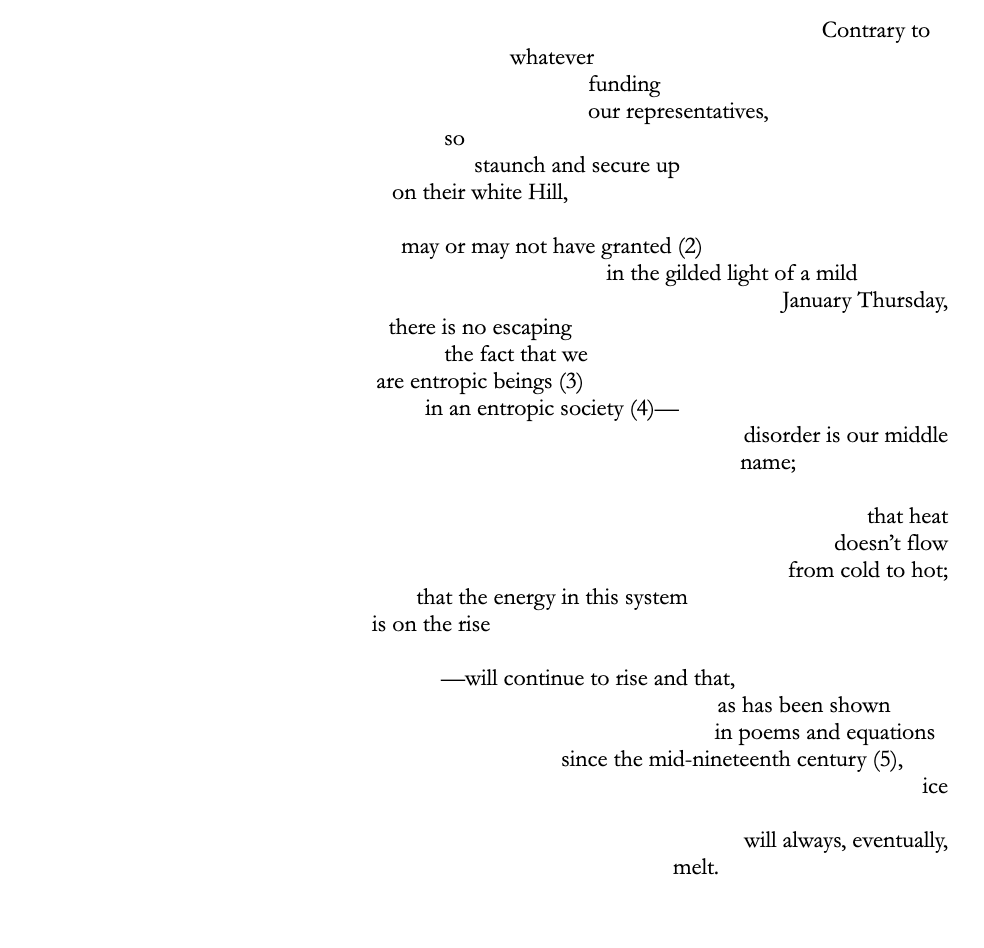
A conceptual, but not mathematically rigorous, summary of the Second Law is that uneven distributions of energy tend to even out over time. This is the result of the combination of chance and the conservation of energy and momentum. It is hard to prove for a general case, but it is easy to posit convincing examples.
To take an example involving kinetic energy, if you fire a fast-moving particle (e.g. a bullet) into a box of slower ones (or a crowd), you have a very uneven initial distribution of energy. Over time, the fast-moving particle will trigger a succession of random collisions in which its excess energy will be lost and the average energy of all the other particles will increase slightly, unless they are killed.
(2) “WASHINGTON – The House of Representatives today passed an appropriations bill that would renew ICE’s excessive budget, with no strings attached, adding to the over $170 billion in taxpayer funds already allocated for immigration enforcement in July 2025.” (aclu.org. January 22, 2026)
(3)In Statistical Physics entropy is defined as
𝑆=𝑘𝐵⋅lnΩ
where Ω is the number of accessible micro-states (6)
(4) To put it another way, entropy (𝑆) is a fundamental property in thermodynamics representing the measure of a system's thermal energy per unit temperature that is unavailable for doing useful work—often interpreted as a measure of disorder or uncertainty. Crowds generally have high entropy compared to individuals, who are usually much more efficient at doing useful work.
(5) In 1850, the German scientist Rudolf Clausius laid the foundation for the second law of thermodynamics by examining the relation between heat transfer and work: Heat can never pass from a colder to a warmer body without some other change, connected therewith, occurring at the same time. E.g., A medic unable to pass through a ring of ICE guards to reach a dying woman’s body.
(6) Minnesota is generally not included as accessible
Family History. / Thomas Page
Please mark in either column the following conditions for any conditions you or a family member have or have had in the past:
Alcoholism / Drug Abuse what can we call excess or just librations
Asthma when the way your lungs feel after a drink
Cancer (please define which) to celebrate the way our cells do decay
Depression / Anxiety / Bipolar / Suicide in the face of the prospect of death
Diabetes (please define which) do you consider the end to be a sweet light
Emphysema a crushing weight on your chest as if
Heart Disease your core is breaking into pieces
High Cholesterol as the fat falls off the bones
Hypertension in a display of immense implosion
Hypothyroidism like a deflated geyser of all the cells
Migraines or a vice wound around the sutures
Strokes cutting all circulation to your mind?
Other (please define which) what do you call that then?
Adult Daughters and Sponges / Sarah Paley
The connection between adult daughters and sponges is tangible.
The adult daughter is not a competent caretaker of a dying mother.
She’d like for her to have a peaceful death. She’d like to fullfill
her role seamlessly, lovingly, patiently and never think about
how daughters and mothers’ relationships are often fraught
and complicated. The adult daughter takes a tiny sponge provided
by the hospice and dips it into water and squeezes it onto
her mother’s dry lips. She hopes that some of the water will
make it down her mother’s slaked throat. People are parched
when they are dying. This is something she didn’t know and she’s
pretty sure her mother didn’t know but now there’s no way to ask
the mother. There’s another sponge, this one larger for “sponge
baths.” It’s an unusually shaped sponge devoid of color. It looks
as if it was plucked out of the sea where it had been alive
and beautiful. When the adult daughter attempts to wash her mother
with this genuine article a nurse officiously takes over. The adult
daughter tries to hide her relief. Was she incompetent on purpose?
Sometimes adult daughters are unable or unwilling to fulfill their roles.
She tidies up the Lazy Boy she’s been living on for the past week
as the nurse finishes her administrations to the adult daughter’s
mother. The nurse comments on the handy hands that made the quilt
the adult daughter is folding, and takes the tiny sponge out of the bowl
of water at the mother’s bedside and throws it in the trash bin. She sees
the look of concern on the adult daughter’s face and says “Don’t worry,
plenty more where that came from.” The adult daughter helps put a new
top sheet on over her disappearing mother. As they tuck in the end,
the nurse, who knows the adult daughter is wondering when this will
all be over, says “I can always tell by their feet. They change color. Look
at her feet from time to time.” The adult daughter nods with gratitude.
The nurse takes a tiny sponge from her pocket and puts it in the daughter’s palm.
She pulls a chair to the bedside, places her hand on her mother’s hand and recites
too loudly:
“The owl and the pussycat went to sea…”
Mentor Text / Amy Snodgrass
after reading Tess Gallagher’s “Now that I am Never Alone”
I admit it: I rolled my eyes
at the title, expecting a cliché,
a well-written whine
about how having kids
interrupts the creative process.
Oh, my lack of faith.
Oh, Tess. I doubted you.
I find no strollers, no nap times,
no pencil-flinging resentment.
Instead: a moth
that clings to tile and rips
to shreds my misplaced cynicism.
You douse my pain with water:
first scalding hot then cold in memory.
Your spring is the tree that roughed my arches to bleed,
your handfuls are the hours of bedside waiting.
I am not sure I can survive your brightest now.
I am not sure I can withstand this raw fluttering.
I am not sure I can write, ever, another word.
