
September - Poem 4
Atomic Tourism / Laura Bandy
Atomic tourism is the most amazing coping mechanism that the people of southern Nevada came up with to deal with the fact that their own government was bombing them. It was a phenomenon where people would come to Vegas to watch the detonations and people would dress up. —Claire Vaye Watkins, Fresh Air, 2026
Tourists come around our town for the Lincoln sites. Not to our town, of course—they can find cornfields and prisons in their own backyards—but nearby, in Springfield, where he lived. There’s the Abraham Lincoln Library, the museum with his unnerving hologram, the Lincoln-Herndon Law Offices Historic site, and his home, where he and Mary shared a bed. Across the street, you can buy ice cream to lick while taking it all in. When Chicago Mayor Richard M. Daley’s wife got wind that Kentucky was trying to claim Lincoln again, she formed a committee to put a stop to that nonsense. They needed an artist to make things look low key, but ignored me, thankfully, at the meetings (what use a poet, really, for anything). While Maggie Daley whipped the committee members who were listening into an Illinois frenzy, I gazed out the window at the Lincoln Square movie theater where a thin man was teetering at the top of a ladder, carefully lettering Atomic Blonde onto the old-fashioned marquee. I had not heard of that one and wondered at the title—did atomic describe the lead’s hair color? What hue of blonde is bomb? It looked like the kind of playhouse left over from another age, where women wore big hats, corsets and steel-hooped cage crinolines under smooth muslin, and men dressed sharp in dark broadcloth, wool vests, and frock coats lined with silk or polished cotton. Since immersion baths were rare, even for the rich, animalic extracts of musk and ambergris were splashed liberally to mask the stench. Maybe the gentlemen stepped out at slow moments in the show to smoke cheroots and plan capitalism, or maybe they stayed in their seats through every act, every last scene.
Sonny / Alicia Boemi
I remember the weight of those silver steel doors that kept you,
and your friends—
trapped in a burdensome manner,
safe but not secure,
uncomfortable but tolerable.
I couldn't help but lock eyes with you,
your eyes were incredibly bright blue.
The heat was searing out that day,
heedful, we went for a walk.
And, even though you couldn't hear me say your name,
you looked up at me. Relieved. Delighted. Thankful.
Merciful you were to the humans who left you,
including me, who,
cried on her way home after I left you.
Heartsore for you—
and all the dogs I loved,
but could not mother.
The Role of Art in Late-Stage American Capitalism / Jesse DeLong
Maybe our mistake was
we should have designed
our poems like the Ford Pinto
or that washing machine
that must be replaced every six years. Maybe
our poems should break down
continuously in the reader’s mind
or make them
feel like they do drinking a Diet Coke
for breakfast. We errored
in letting readers have a favorite
sad song they read at every funeral.
We blundered in giving for free
our labor at coffee shops
and open mic nights
or in the backrooms of libraries. Don’t even
get me started on libraries. The ending
of this poem shouldn’t even satisfy you.
To feel something, anything now,
comes at a cost. Instead, it should ask you
to hand over your credit card
information. Anyways, here’s my venmo:
@Jesse-DeLong-2
Please send me $5.
Who is most to blame / Shelly Krehbiel
Can you be okay with not knowing?
the couples therapist asks.
The woman rolls her eyes. The man looks down,
searching for what he cannot say.
In a year they will be divorced. In a year
the tree they planted when they bought the house
will be dropping peaches into grass kept green
only by its shade. Who could stay here?
she will ask, as she shuts the door for the last time,
their things neatly halved, the new owners
unknown to either of them and coming soon.
Years after that, he will sit on his porch
in another hot Kansas summer and ask himself
What was the name of that peach tree?
And though it was Reliance, he will remember it
as Resilience. No one will correct him.
For Rachel Blau Duplessis, / rob mclennan
Blue, legion. Drafts. A polyvocal entry. One’s ear, to lend. A visual, daily practice. Days and works and days. Cartographic, the position of collage. This vanishing point. A sure cure, applied. Categories. So necessary, membrane. How big a threat? What, temporality. How grand, this arrangement of stars. Encompassed. The onset, journey. Heart, and blood, and facts. An ocean. The structural divisions of trees, thin lines of fence. How redundant the aesthetic. Leaves tarnish, fall, and then. Thus, exegesis. These scraps of humanity, assembled. Chorus.
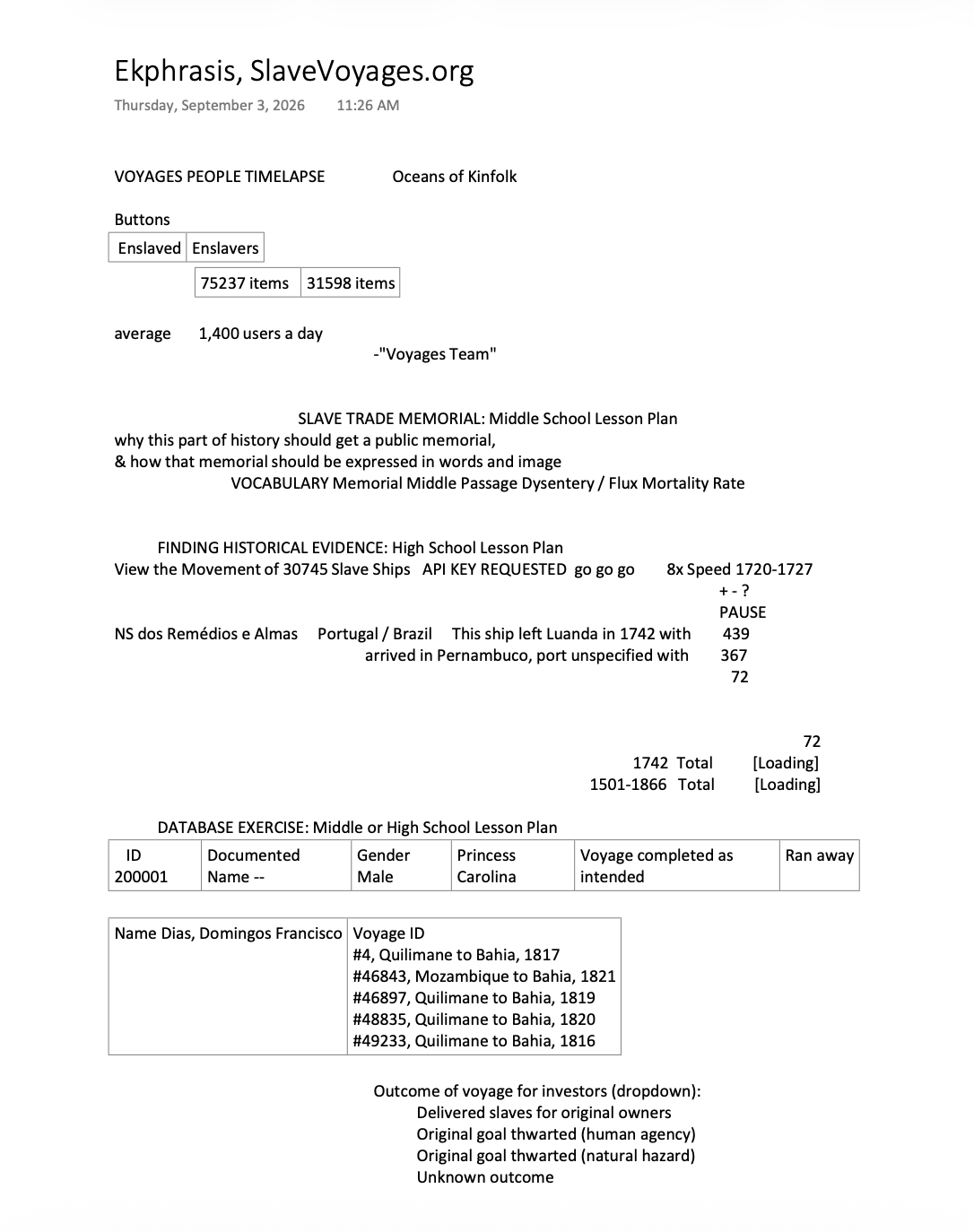
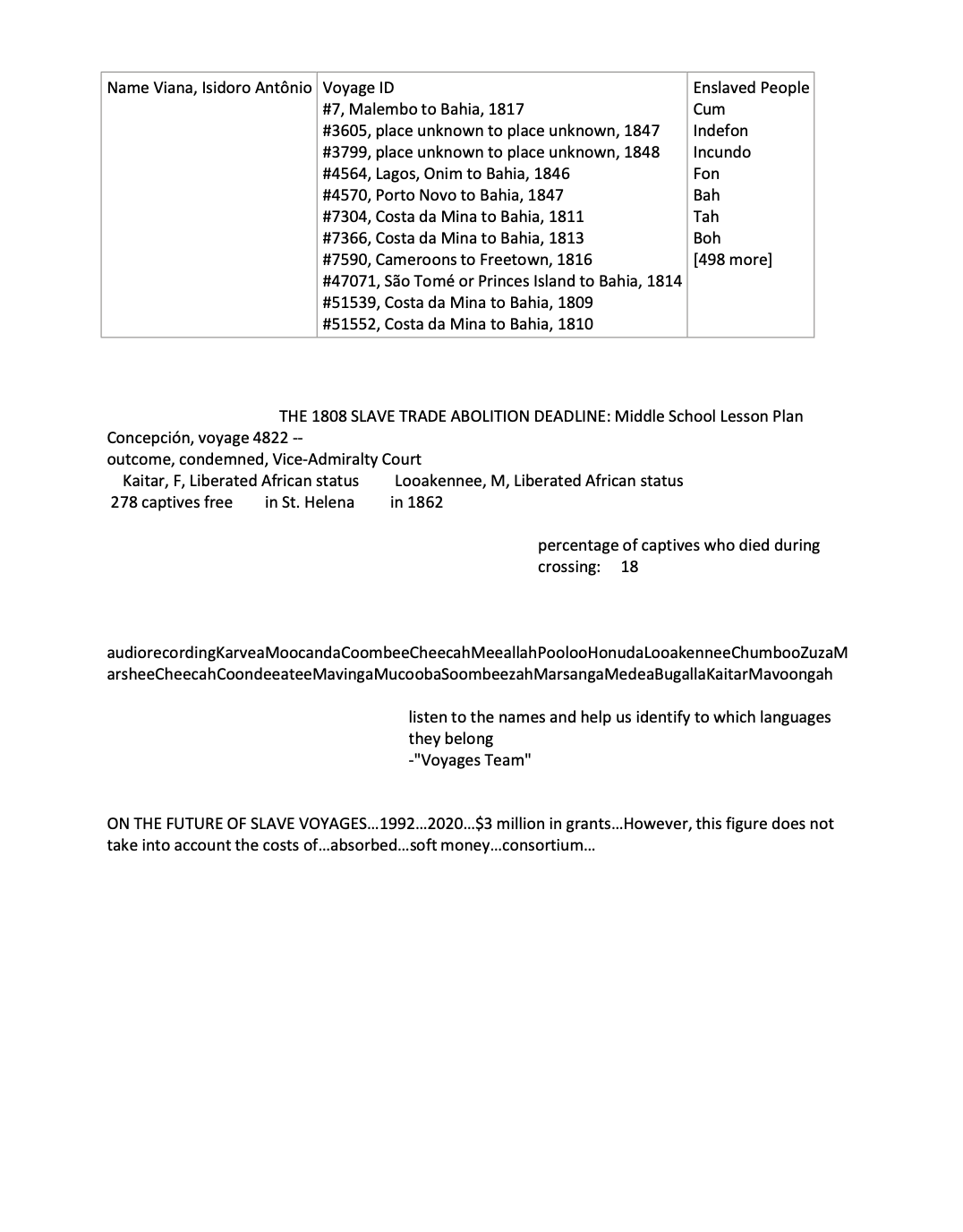
Ekphrasis, SlaveVoyages.org / Piper Rasmussen
el niño / Connor Simons
the child is growing in the pacific and did you ever think
our boy would get to be so big? you don’t know the father
but we all have kept him fed on a steady diet of plastic
and cow shit thwarted environmental reviews and rapid
easements for roads to plunge deeper into the vine-thick
depths of increasingly nervous jungles it takes a village
but maybe we spoiled him he curls his fist and mounds
of dead fish boiled from the inside out line the beaches
like cairns on a steppe when he sees the previous year’s
work erased by excavators and emergency response teams
he caterwauls a punishing wind he’s coming home
and somewhere in the sierra nevadas a hermit thrush
scrambles to find the last of autumn’s berries strewn
beneath pine needles on the tinderbox-forest’s floor
A Joke Just for Me / Veronica Vo
Friend said something unexpected
yet funny and I laughed,
looked over to find them watching me,
waiting for that reaction, realized –
friends have said and done things
just to get me to smile,
just to make me laugh,
isn’t that beautiful,
imagine thinking of ways to
get someone to move
their mouth a certain way
or make a sound that conveys joy,
imagine putting in effort to do that,
imagine being loved like that.
Other Words for Atrophy / Melinda Wilson
“All that land between
yesterday and today, and
the when and how of
your life somewhere there.” —Joshua Edwards
Before there is death
and when there is pain,
a cat will purr loudly
to lull itself to the great sleep.
My aged fox terrier
licks her bed repeatedly,
paces the long hallway,
circles the stairs landing.
She attempts to quiet,
we think,
the terror of a mind
deleting itself in small
stages of expansion,
all marked by a decline
we can hardly assess.
When our sights tiptoe away,
the changes are so slight
it’s hard to spot
the perimeter of dark
at any distance,
the slow dissolution
of the herd, and the lone
llama in the field
when the fog clears.
