
September - Poem 20
Nature Poem / Laura Bandy
The news is ugly, so I go outside. I decide
to write a nature poem. Most often when
I scribble, my poems contain humans.
Not this one. Who, then, is speaking?
Let’s begin with the trees, specifically
the new maple shooting up its sap green
leaves that teeter on a spindly stalk. We
brought him in as a replacement when
the most recent Midwest tornado took out
our beloved oak, split her massive 100-year
plus trunk like a wet toothpick, then shoved
her blooming arms through our window. See
how one becomes two? We want to root for
this baby tree to make it, want to care that he
bursts forth blazing orange growth in fall,
so that when the sun hits be-leaved branches
just right, our house is bathed in honey glow
as it was every autumn before the storm. But
we, weary beings, know this sapling can’t
deliver. Maybe turn this over to the birds who
find any high perch sweet, or the late summer
clouds that seem Nimbus today, rain-bearing,
ready to water any and all roots. Nature doesn’t
judge, has no opinion on past or future; only
present resonates—where the nuts and berries,
when the lightning strike, what furred creature
to run from in the dark—there is no why, no
how. Out this window, my husband’s car backs
down the driveway, fender drooping from when
I borrowed it and hit that deer that darted, as they
do, into the road at night. They leap that way
because they have to, nature demands it, then go
blind in bright headlights. You know who, now.
Worth the Money / Alicia Boemi
The last time I saw my dad, he had yellow eyes.
I thought to myself: He will die; he is sick.
He handed me my grandmother’s straw hat and said,
“This hat is worth money.”
Everything worth something needed to be worth money,
to him.
Growing up, I just wanted to be worth something
to him.
He died five days later.
Sometimes I wear that straw hat.
Today, my toddler wore that straw hat,
crookedly on her tiny head,
it made us laugh and smile.
Worth it? I think so.
Marginal Notes on Calculations by Judith K. Walker / Jesse DeLong
“The statements in mathematics are permanent, so really, they’re about your own inevitable death.”
When people experience a beautiful piece of music or a particularly moving piece of art, a specific area of the brain will activate. Neurobiologists have shown that this same area activates when mathematicians are fascinated by an equation.
“He knew about the MIT study. He’d read about how they’d asked participants to pick a number between 1 and 20. He was aware that, mathematically, 17 was the most common answer. But no matter how many times he’d presented this choice to people he was familiar with—his wife, his son, his colleagues in other departments—they’ never fall in line.”
Like that Cohen Brothers' movie, A Serious Man, where a physicist up for review is asked what he’s published, and he looks at them stupefied, as if he’d never even thought about it, and responds, “I haven’t published anything.”
That one renga where the clapping of erasers is linked to thunder.
Grocery stores don’t even carry that brand anymore.
“He’d calculated the probability of the major events of his life, how likely they were to happen, and came away with the depressing realization that he was, like most of us, ordinary.”
Like the time in Geometry class when you noticed the line of ants running along the tiles towards a crack in the wall, and your teacher, careful not to disturb their order, stepped over them as she filled the board with equations.
“When his son turned 17, he told him about the commonality of the number. His son simply looked down at the greasy egg on his plate, fried so hard the ends were dry, and flipped his hoodie over his ears.”
The word choice of ears, here, instead of head or hair.
How high school wrestlers will wear garbage bags and spit into plastic cups to make the perfect weight, and how, if at a meet, they find a scale more generous than others, they will form a line for the more lenient numbers.
“The number of years his parents had been married. His state rank on the high school chess league. The number of school’s he’d applied to. The amount of dates he’d had with his wife before asking her to marry him. The number of months they’d tried before conceiving. The amount of people he could count as actual friends. The distance, in kilometers, from his house to the university.”
That’s nice. But will you really use that in the real world?
Between Continents / Shelly Krehbiel
Reykjanes peninsula, Iceland
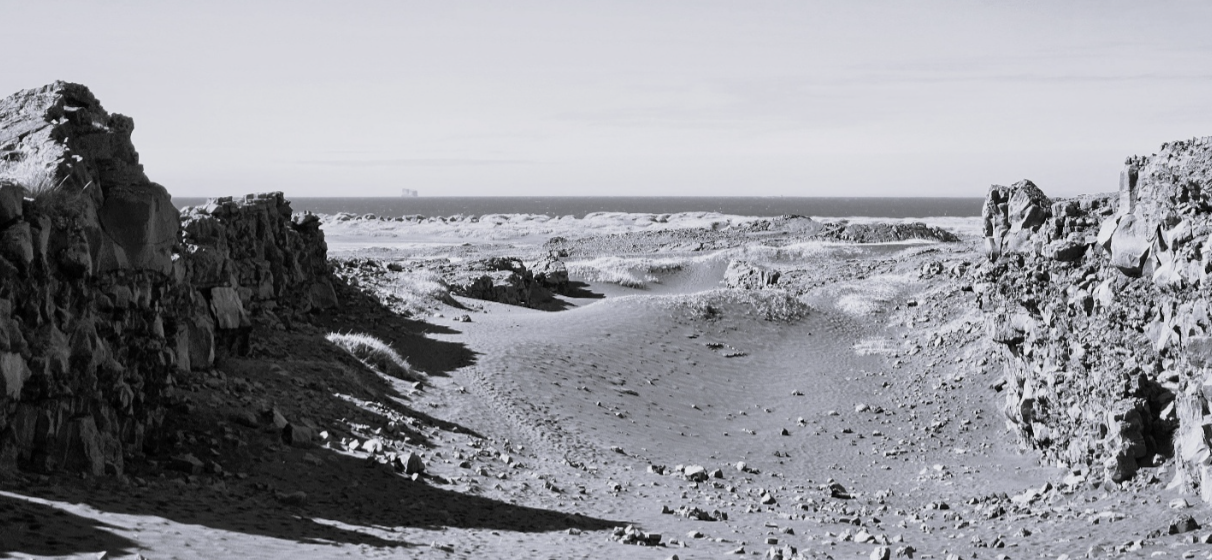
this place says that when we leave each other, it will be a little at a time. sand filling in the gaps
until it can’t anymore. until it falls through. what then? do we just keep moving further and
further apart, millimeters at a time? look at how the shadows trail behind you for a while, like
oak branches shedding their first leaves in september wind. when the sun passes over it will be
my darkness stretching back, like the crow feather as it floated near the river. imagine what it
will be like when there is enough room for the ocean between us. a whole ocean. maybe it is
possible, unimaginable years from now, for us to meet again on the other side, versions of us
crashing together into a horizon of new mountains, an island no one expected.
For Fred Wah, / rob mclennan
What if we said we were. Pressure-treated, commonplace. Iron, shale. The treeline this morning. Confirmation. This, question. Turns, smooth and snow. Separation, dialogue. Monologue. Monolith. Walking path, trail. Further footsore, streaks. Eating weeds. You know what the continent. Hillside, or into a forest. A staircase, descends. Upon cobbled stone. Branches, fossil. Microscopic. History professors, the sweet summer wind. To set out as numbers. History, professes. All out of sequence. Glimpses, direct. Don’t speak, pause. Erosion, gathers. Ecocaution. Current threat level: high. These sticks, held in lake mud. The rear wheel. Vancouver loves you. Some feathers wet, Kootenays. I’ll have what he’s having.
Mesostic on Electricity, Sound, and Light, Chapter 4: Galvanometer Constant of a Moving Galvanometer / Piper Rasmussen
iT is seen
may not Remain constant
restAtement of definition
a unit magNetic pole
Since action and reaction are equal
51. The Motor rule.
imagined merely as an aId to thinking
elaStic
bandS endowed
with the followIng properties
pOles
repulsioN
one single lOop
toward the reader with a Force of [] dynes and the right
Side is urged away
suppose thaT
equilibRium is
Established
the result is precisely the Same
whatever itS shape
Expression
showS
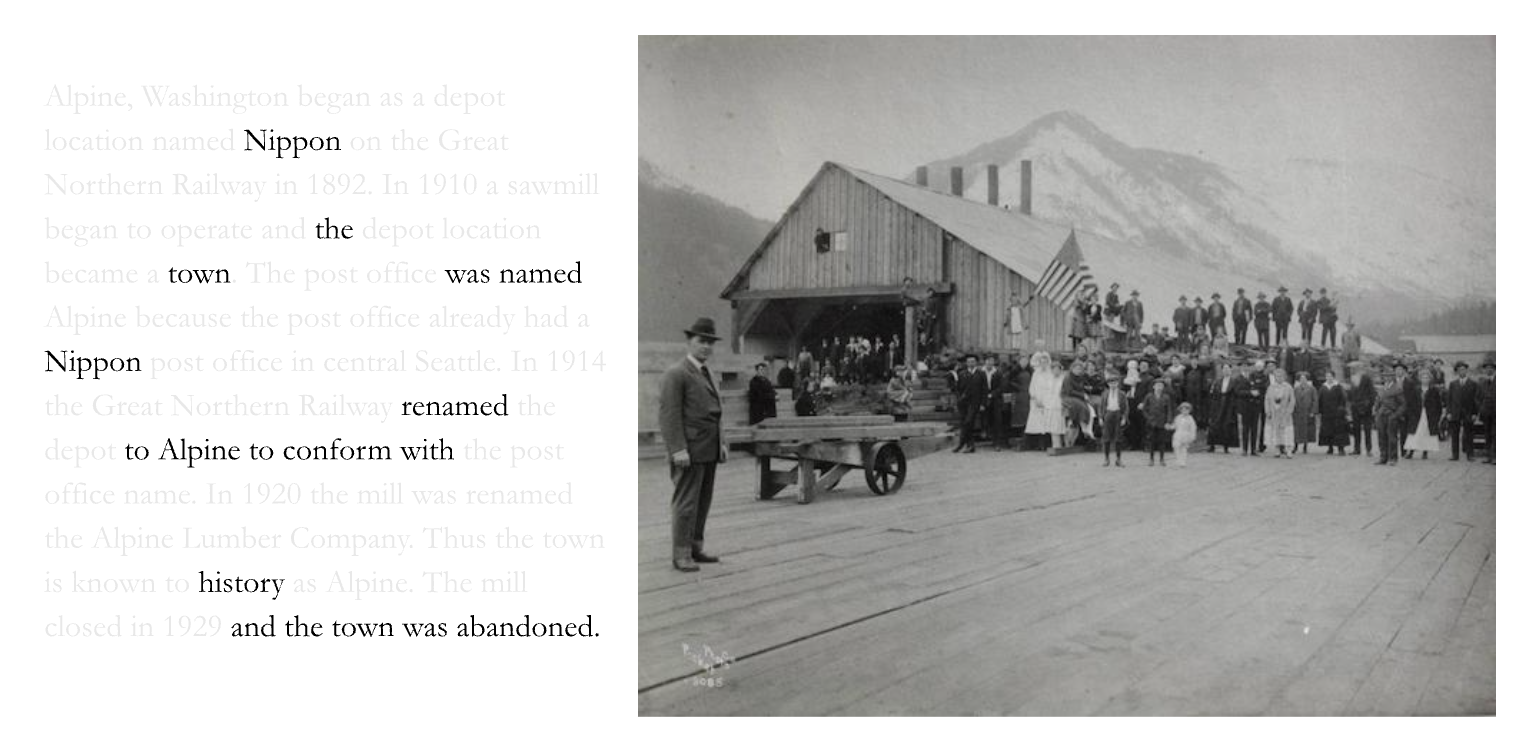
Alpine/Nippon / Connor Simons
NAME: Alpine COMMENTS: Near Skykomish
COUNTY: King REMAINS: Nothing.
ROADS: 4WD
GRID: 1
CLIMATE: Snow in winter, hot in summer
BEST TIME TO VISIT: Summer, early fall before snow
Nesting Doll Poem / Veronica Vo
Tears welling under fluorescent parking lot lighting,
say you love me and mean it,
even if you remind me of someone else.
The girl before you broke my heart and so will
the one after. You deserved more than me wanting you to
say you love me and mean it,
even when I couldn’t do the same, no matter
how much I wanted to. And I wanted to.
Growing up, my parents didn’t tell me they loved me,
but things changed and I can’t remember when. I used to
think it needed to be rationed. The more you
say you love me and mean it,
the less it means. I used to think like that. I used to think
a lot of things that were wrong. I still do, but I can’t tell
what time will tell. All I know is that it will.
My childhood best friend used to bring me nesting dolls
from Russia. She was good to me, but now she is
someone I don’t know and we don’t speak anymore.
The worst part is that I will always have her in my heart.
Saying you love me and meaning it,
that’s not the hard part. The hard part is knowing
rather than remembering. A friend asks if she can ask
me about my mother. Do you feel less close to her now,
because of memory? I ask her what closeness means.
I watched a video of someone breaking open
a container of red liquid on their chest with a hammer.
I don’t know what it means to know someone. There is so much
about me my parents don’t know. Does any of it matter?
Does loving require knowing? Knowing does not require loving. She
says she loves me and means it.
I know she means it. If I was born from her, raised by her,
does that mean she knows me? Even if we
spend so much time in silence. Even if she doesn’t want to know
that I will never love like she wants me to, my muse. A nesting doll
will always know where it came from, even if removed.
No Moonlight / No Moonshine / Melinda Wilson
No lumens tonight.
Only stars’ blurry glow from
behind cushion clouds.
